Advanced dermal filler trainingfor nurses in Ontario
Advanced dermal filler training at Bradford Skin Clinic and Medical Spa in Bradford, Ontario is for nurses already injecting, taught by Alex Dinovich, Nurse Practitioner and Medical Director. It covers deeper facial anatomy, tissue planes, vascular risk and product selection. Fillers are Class III medical devices, not prescription drugs, but an RN or RPN still needs an authorizing mechanism to inject them.
Written and reviewed by Alex Dinovich, NP, Nurse Practitioner and Medical Director at Bradford Skin Clinic & Medical Spa.
College of Nurses of Ontario registration 13564840, verifiable on the
public Find a Nurse register.
Last reviewed .
At a glance
The short version.
InvestmentConfirmed when you enquire. Product, models and room time all sit inside the fee and we will itemise them for you
FormatIn person, in our Bradford treatment rooms
Who it is forCurrent registration with the College of Nurses of Ontario as an RN, RPN or NP, plus existing hands on filler experience
What the course includes
Placeholder. This list is stand-in copy while the
clinic confirms the detail. Anything in square brackets is an open question.
Included in the course fee
[N] contact hours, small group, in the clinic
Cannula technique for the lower face and lips
Product selection across the hyaluronic acid range
Vascular anatomy of the danger zones, and how to stay out of them
Supervised injecting on live models
[To confirm with Alex: prerequisites, group size, whether models are provided]
Not included: an authorising mechanism. The course gives you competence. Authority is a separate thing, and it comes from an authorised provider.
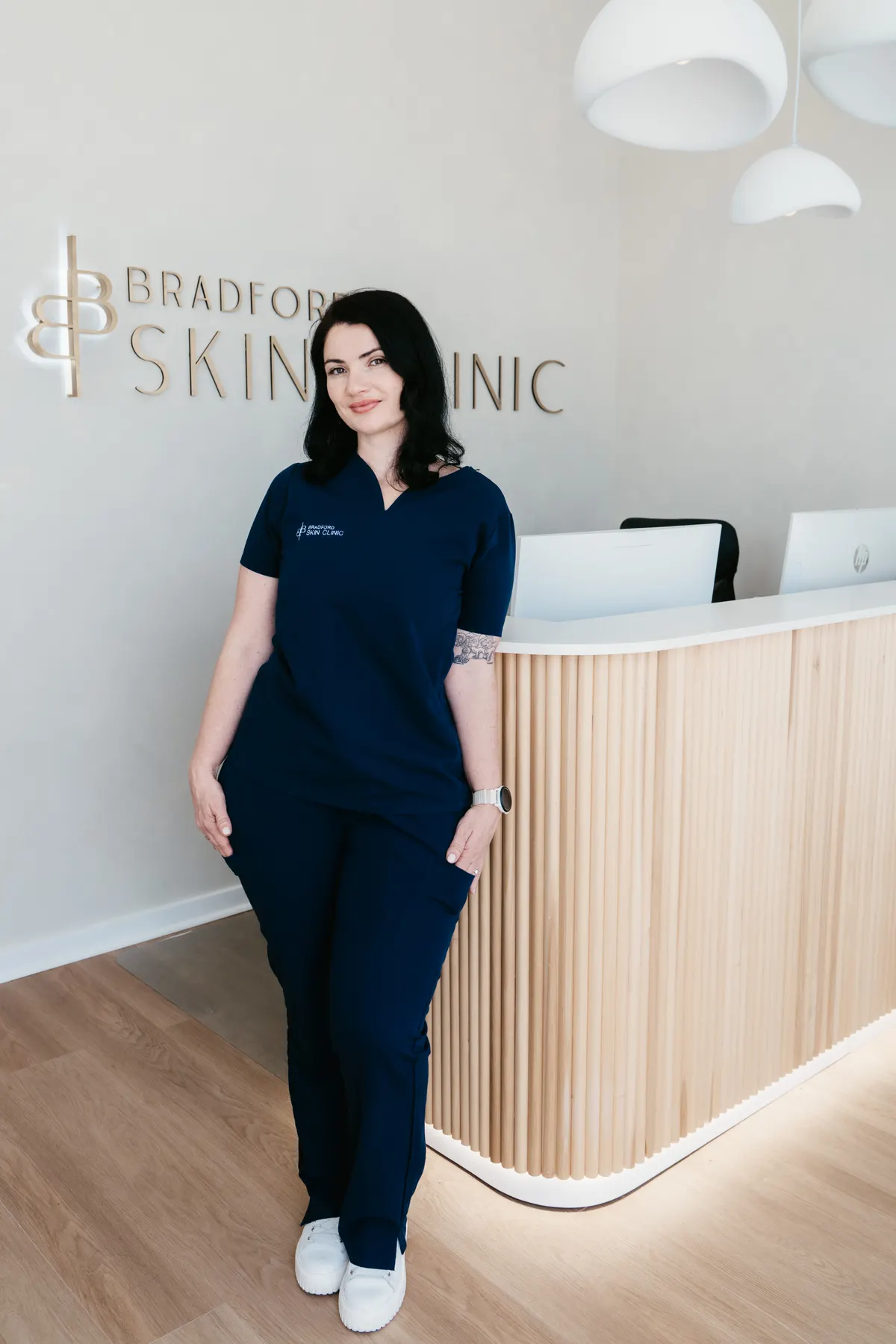
Where you will be standing
The room, not a slide deck.
You inject here, in a room that is running clinics the rest of the week.Assessment is taught in the room where assessment happens.Cohort size is confirmed in writing before you pay.
What the course gives you
Technique, on real anatomy.
Assessment, consent and documentation.
Competence you can demonstrate.
What you still need
Current registration with the College of Nurses of Ontario.
An authorising mechanism from an authorised provider.
A directive or a direct order that covers what you actually do.
Competence is not authority.
Ontario issues no injector licence, and no course grants legal authority to inject.
We can author the mechanism. You are not obliged to use us for it.
Taught on real anatomy, in a working treatment room.
Advanced dermal filler training is for nurses who already inject filler and want to work in harder anatomy with better judgement. It is taught at Bradford Skin Clinic and Medical Spa in Bradford, Ontario by Alex Dinovich, Nurse Practitioner and Medical Director, in the treatment rooms the clinic uses for patients. It raises your competence. It does not change your authority, and if you are an RN or an RPN your authority still comes from an authorizing mechanism written by an authorized provider.
Advanced means the anatomy, not the treatment menu
An advanced filler course earns the word when it is organised around vascular anatomy and tissue planes, not around a longer list of areas.
Plenty of courses market themselves as advanced because they add regions. That is a menu, not a level. What actually separates an advanced injector from a competent one is the ability to hold a three dimensional picture of the face in mind while working: which vessel runs where at this depth in this patient, why this plane and not the one above it, what the product will do in that plane over the next six months, and what the exit route is if the assessment is wrong.
That is why our teaching runs in a fixed order. Anatomy and vascular risk first. Plane and product decision second. Technique third. If you have sat through a course that reversed those, you will recognise the feeling of having learned a pattern without learning why.
Fillers are devices, not drugs, and the authority rule is unchanged
Health Canada regulates dermal fillers as Class III medical devices. They are not prescription drugs. You still cannot initiate the controlled acts involved in injecting one.
This is worth spelling out because Ontario injector marketing gets it wrong constantly, usually in one of two directions.
The first error is treating filler as a prescription product. It is not. There is no drug schedule and no prescribing decision for a hyaluronic acid filler in the sense there is for a neuromodulator. Health Canada’s medical device framework governs it, with permanent fillers sitting in Class IV.
The second error is the dangerous one: concluding that because there is no prescription, filler carries a lighter obligation. The authority requirement for filler was never about drug scheduling. It comes from the Regulated Health Professions Act, 1991, and specifically from two controlled acts. Administering a substance by injection is one. Performing a prescribed procedure below the dermis is the other. An RN or an RPN cannot initiate either of them. So a directive or a direct order from an authorized provider is required for filler exactly as it is for a neuromodulator.
Filler also happens to be the modality where things go badly fastest. Vascular occlusion is a filler problem. The provider that tells you filler is the relaxed one has told you everything you need to know about the quality of the teaching.
What advanced training changes about your practice
The measurable change is in what you decline, not only in what you attempt.
Injectors who genuinely advance get slower before they get faster. They start refusing work they would previously have taken, because they can now see the anatomy that makes a particular request a poor idea in a particular face. They ask for more history. They photograph more carefully. They write notes that record the reasoning and not just the volume.
They also get better at the conversation. A client who wants an outcome her anatomy will not give her is a clinical problem, a commercial problem and a complaint risk all at once, and the skill of saying no warmly is as learnable as the injecting.
The scope of your directive does not grow with your skill
An advanced course does not widen your authorizing mechanism, and assuming it does is a compliance failure waiting to happen.
If you hold a directive that covers a defined set of clients and circumstances, that document sets your limits. Learning a new region on a course does not add that region to the directive. The directive has to be revised by the authorized provider who wrote it, in writing, before you work to the wider scope.
This is a genuinely common trap. A nurse trains up, starts offering a new area, and never goes back to the person who authorized her. The clinical skill is real. The authority is not there. If that describes your plan for after this course, talk to whoever holds your authorizing mechanism first, and if that person is us, we will revise it or explain why we will not. Medical directorship sets out how that relationship works.
Complications are the reason this course is careful
Advanced filler work raises what you can achieve and it raises what you can cause.
The CNO Aesthetic Services practice guideline dated 3 July 2026 requires emergency response protocols, which means a nurse injecting filler now has a documented compliance obligation to be ready for the emergency, not merely a clinical instinct about it. Knowing the theory of vascular occlusion is not the same as having a protocol, the product, the pathway and the practised sequence.
We teach complication readiness as its own subject rather than a closing slide. Complication management training covers it properly, and if you are moving into higher risk filler work without it, you are advancing the risk faster than the response.
Who this course is for, honestly
It is for the injector who has done enough to know what she does not know.
If you have completed a foundation course and treated a handful of people, this is probably too early, and the foundation injector course plus time on the tools will serve you better. If you are injecting weekly, comfortable with technique, and finding that your ceiling is judgement rather than dexterity, this is the right room.
We assess that at enquiry, not on the day. If you are not ready, we will tell you before you pay rather than after, and we would rather lose the booking than teach advanced anatomy to someone still thinking about where to put her hands. For what training in this province actually costs and what should be inside the fee, read injector training cost. For how the whole programme fits together, start at injector training.
Asked by nurses
Asked and answered.
How much experience do I need before booking this?
You need to be injecting filler already, comfortably and regularly, not just to have completed a foundation course. Advanced training assumes you can handle a needle and a cannula without thinking about it, so the teaching can be about anatomy, planes and decision making. If you are not there yet, we will tell you at enquiry and point you at the foundation course instead. Turning people away is cheaper for everyone than teaching over a shaky base.
Do fillers need a prescription in Canada?
No. Health Canada regulates dermal fillers as Class III medical devices, and permanent fillers as Class IV. They are not prescription drugs, so there is no drug schedule involved. This is the single most misstated fact in Ontario injector marketing. It does not mean fillers are unregulated for you: the authority you need comes from the controlled acts, not from drug scheduling.
So can I inject filler without an authorizing mechanism because it is not a drug?
No, and this is the trap. Injecting a filler is still administering a substance by injection and still performing a prescribed procedure below the dermis, which are two controlled acts under the Regulated Health Professions Act, 1991. An RN or an RPN cannot initiate either. You need a direct order or a directive from an authorized provider regardless of the fact that no prescription exists for the product.
Which areas does advanced training cover?
The regions covered are confirmed when you enquire, because the syllabus is set against the cohort rather than sold as a fixed list. What is fixed is the approach: vascular anatomy first, plane and product decision second, technique third. Any course that leads with a list of glamorous treatment areas and gets to anatomy afterwards has the order backwards.
Do you teach cannula or needle?
Both, because the choice between them is part of what advanced practice means. A cannula is not a safety guarantee and a needle is not automatically reckless. The teachable skill is knowing which one the anatomy and the plane in front of you calls for, and being able to say why in your notes if anyone ever asks.
Is complication management included?
Complication awareness runs through the filler teaching, but full complication management is taught as its own course and we recommend it strongly rather than folding it in as a footnote. The CNO Aesthetic Services practice guideline dated 3 July 2026 requires emergency response protocols, so this is now a compliance topic as well as a clinical one. See complication management training.
Will I be able to work independently after advanced training?
Not if you are an RN or an RPN. Advanced training raises your competence, and competence is not authority. Your authority still comes from an authorizing mechanism issued by an authorized provider, and it still has the scope and conditions that document sets. Advancing your skills does not widen a directive that was written for something narrower.
How many models will I treat?
Confirmed when you enquire, in writing, before you pay. We have not published a number because it depends on the cohort and because inflated model counts are the most common exaggeration in this market. Ask every provider for the figure in writing and compare like with like.
Sources
Where this comes from.
Everything on this page is drawn from the regulator, not from a
competitor's marketing. Read the originals rather than taking our word for any of it.
General information about Ontario regulatory requirements. Not
legal or regulatory advice. Nurses remain accountable to the College of Nurses of Ontario
for their own practice decisions.
Talk to us
Ask before you commit to anything.
Leave four details and Alex will come back to you directly. If what
you need is not something we do, we will say so and point you at whoever does.

 Written and reviewed by Alex Dinovich, NP, Nurse Practitioner and Medical Director at Bradford Skin Clinic & Medical Spa.
College of Nurses of Ontario registration 13564840, verifiable on the
public Find a Nurse register.
Last reviewed .
Written and reviewed by Alex Dinovich, NP, Nurse Practitioner and Medical Director at Bradford Skin Clinic & Medical Spa.
College of Nurses of Ontario registration 13564840, verifiable on the
public Find a Nurse register.
Last reviewed .