Directives and delegationexplained for Ontario nurses
A directive authorizes a nurse to perform a controlled act for any client who meets written conditions, a direct order authorizes it for one named client, and delegation transfers an act to someone outside their scope. Bradford Skin Clinic and Medical Spa in Bradford, Ontario authors these documents for Ontario nurse injectors through Alex Dinovich, Nurse Practitioner and Medical Director.
Written and reviewed by Alex Dinovich, NP, Nurse Practitioner and Medical Director at Bradford Skin Clinic & Medical Spa.
College of Nurses of Ontario registration 13564840, verifiable on the
public Find a Nurse register.
Last reviewed .
At a glance
The short version.
InvestmentDocument authorship and maintenance are quoted with the wider arrangement
Who you would be working with
A person, not a signature.
Directorship is a professional relationship rather than a
location. You are choosing the person who authors your mechanism, reviews it as
your practice changes, and picks up when a client does not fit it.
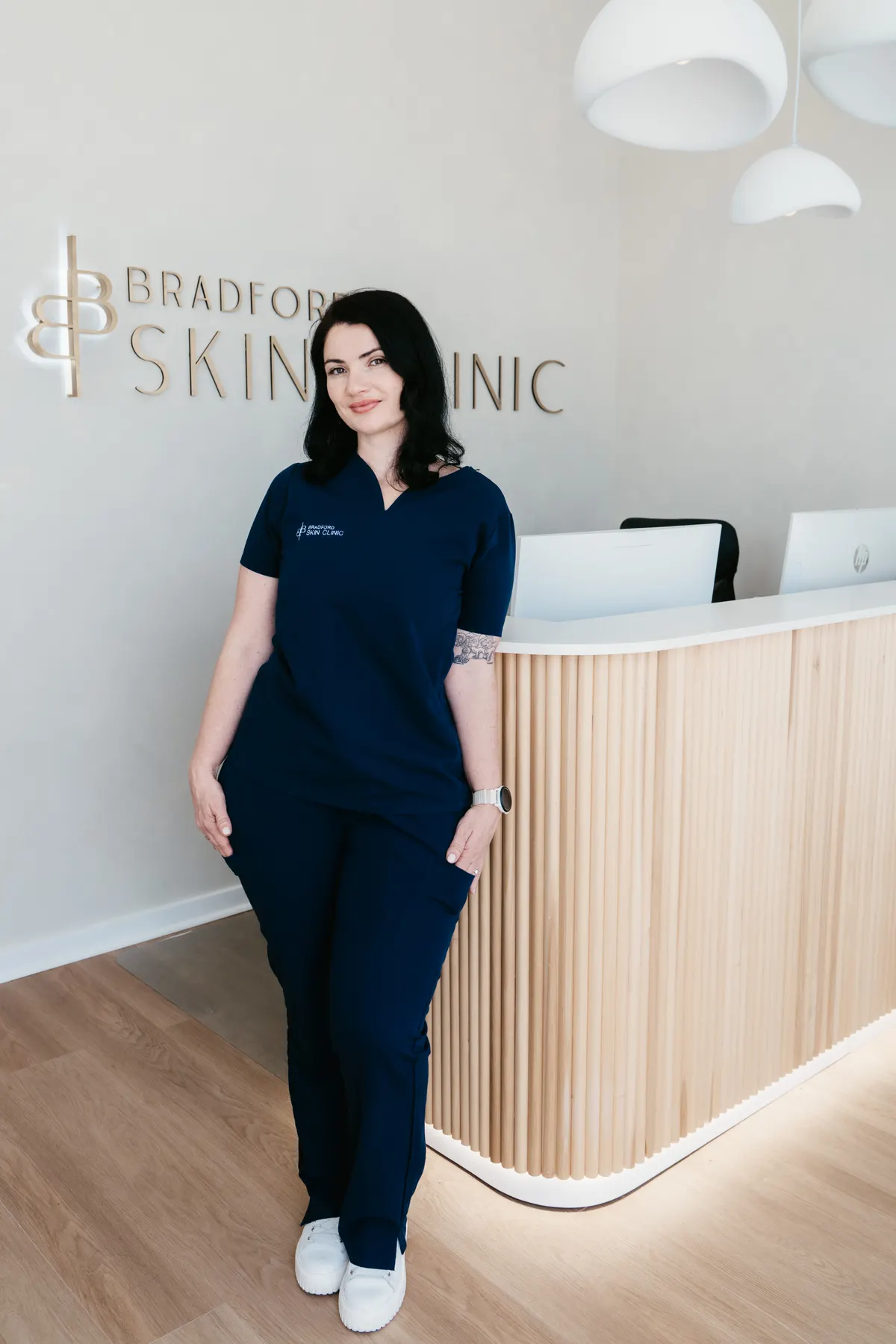
Alex Dinovich is Nurse Practitioner and Medical Director here. She is registered with the College
of Nurses of Ontario as 13564840, verifiable on the
public register.
What a directive gives you
Authority to perform the controlled act it names.
A written mechanism you can show.
A named provider accountable for authoring it.
What it does not cover
Anything the directive does not say.
Competence, which comes from training and practice.
Your own accountability to the College for your own decisions.
A directive covers what it says it covers.
Accountability under an authorizing mechanism is specific and bounded.
You remain accountable to the College of Nurses of Ontario for your own practice.
Alex Dinovich, NP. The authorising provider, not a name on a certificate.
Three words that are not synonyms
Directive, direct order and delegation describe three different instruments, and in aesthetics they are used almost interchangeably by people who should know better.
Getting them straight is not pedantry. Each has a different scope, a different accountability structure and a different set of things it cannot do. If you are working under a document that has been labelled with the wrong word, there is a reasonable chance it was also written with the wrong assumptions.
Here is each one, in the College of Nurses of Ontario’s own vocabulary.
Directive
A directive is a written instrument, issued by an authorized provider, that authorizes a nurse to perform a controlled act for any client who meets the conditions set out in it.
The key feature is that it is written in advance for a class of situations rather than for a person. The authorizing provider has not seen your client. What they have done is anticipate the circumstances in which the intervention is appropriate and write those circumstances down precisely enough for you to apply them yourself.
That is why the conditions carry all the weight. A directive names the intervention, defines the clients it covers, states what must be satisfied before you proceed, and states the situations in which you must stop and consult. Applying it is an act of judgement on your part: you are deciding that the person in front of you is inside the boundary the document draws.
Note the terminology. Nurses say directive; that is CNO’s word. Medical directive is the corresponding usage from the College of Physicians and Surgeons of Ontario. The instruments are close relatives, and physicians issue them too, but if you are a nurse reading your regulator’s guidance, directive is the word you will find there.
Direct order
A direct order authorizes a controlled act for one named client.
The authorized provider has that individual in view. There is no set of conditions to interpret and no class of clients to reason about, because the person has already been identified and the order is for them.
Direct orders are clean and unambiguous. They are also impractical as the sole basis for an aesthetic practice, because they require the authorizing provider to be involved in every client. Most working arrangements use directives for the routine pathway and direct orders for the situations a directive should not try to anticipate.
Delegation
Delegation is the transfer of a controlled act to someone who is not otherwise authorized to perform it.
This is the one most often misapplied in aesthetics. Delegation is for situations where the act sits outside the receiving person’s authorized scope entirely. For an RN or an RPN injecting a neuromodulator or a dermal filler, the controlled acts involved are within the profession’s scope; what is missing is the authority to initiate. That is a directive problem, not a delegation problem.
If somebody is describing your arrangement as delegation, ask why. Sometimes the answer is legitimate and specific. Sometimes it means nobody looked closely at which instrument was actually needed.
Delegation also crosses regulators, and the requirements differ depending on who is delegating and under which College’s rules they practise. Those specifics are confirmed in conversation rather than assumed from a general page, because a physician’s obligations when delegating are set by the College of Physicians and Surgeons of Ontario, and a Nurse Practitioner is regulated by the College of Nurses of Ontario.
Why any of this is needed at all
Because injecting a neuromodulator or a dermal filler involves two controlled acts under the Regulated Health Professions Act, 1991: administering a substance by injection, and performing a prescribed procedure below the dermis.
An RN or RPN may perform these acts but may not initiate them. The instrument that closes that gap is an authorizing mechanism, which in practice means a directive or a direct order.
It is worth restating the point that most competitor pages get wrong. Neuromodulators are prescription drugs; dermal fillers are not. Fillers are Class III medical devices under Health Canada, Class IV where permanent. The authority requirement for filler therefore does not come from drug scheduling, because there is no prescription in the picture. It comes from the controlled acts, and it is exactly as binding.
What a good directive looks like in practice
Six things, and their absence is diagnostic.
A named intervention. Not “aesthetic injections” but the specific acts and the specific product classes.
A defined client group. Described in terms you can apply at the chairside without guessing.
Conditions that must be met. Assessment, consent, contraindications, anything that has to be true before you proceed.
Explicit stop-and-consult triggers. The situations where the answer is to pick up the phone.
Complication handling. What you manage, what you escalate, and how you reach the authorizing provider urgently.
A review date and a named reviewer. Documents rot. Someone has to own that.
A directive missing item three or item four is not a concise directive. It is a document that cannot be applied, because there is no test for whether a given client is inside it.
Who is accountable for what
The authorizing provider is accountable for the mechanism: whether the directive is appropriate, safe, properly conditioned and current.
You are accountable to the College of Nurses of Ontario for the judgement that this client meets the conditions, for having the competence to perform the intervention, and for how you actually perform it.
Nothing in an authorizing mechanism transfers your professional accountability, and no arrangement should be sold to you on the basis that it does. Accountability here is specific and bounded on both sides. That is a feature: it is what makes the structure workable rather than a fiction.
This is under review
The College of Nurses of Ontario published a new Aesthetic Services practice guideline dated 3 July 2026 and has said it continues to review how authorizing mechanisms, including directives and delegation, are used in aesthetic practice.
Requirements may change. Write your documents so they can be revised, and make sure somebody is responsible for revising them.
Getting your documents written
Alex Dinovich, Nurse Practitioner and Medical Director at Bradford Skin Clinic and Medical Spa, holds College of Nurses of Ontario registration 13564840 and authors directives and direct orders for nurses across Ontario, together with the review and revision that keeps them current.
Call 647-333-6805. Bradford Skin Clinic and Medical Spa, 444 Holland Street West, Unit 2, Bradford, Ontario.
Asked by nurses
Asked and answered.
What is the difference between a directive and a direct order?
A directive applies to any client who meets the conditions written into it; a direct order applies to one named client. The directive is written in advance for a defined situation and does not require the authorizing provider to have seen the person in front of you. The direct order is specific to an individual the provider has considered. Both are authorizing mechanisms and both are valid, but they carry different assumptions about who assessed the client.
Is a directive the same thing as delegation?
No, and this is the most common confusion in aesthetics. A directive authorizes you to perform a controlled act that is already within your profession's scope but which you cannot initiate. Delegation transfers a controlled act to someone for whom it is not otherwise authorized at all. For an RN or RPN injecting, a directive is usually the relevant instrument, not delegation.
Should I say medical directive or directive?
When you are speaking as a nurse, say directive. That is the College of Nurses of Ontario's own term in its guidance to nurses. Medical directive is the corresponding usage from the College of Physicians and Surgeons of Ontario, which regulates physicians. The documents are closely related, but using your regulator's vocabulary shows you are reading your regulator's guidance.
What must a directive contain?
The intervention, the clients it covers, the circumstances and conditions that must be met, the situations in which you must stop and consult, and who is accountable for issuing and reviewing it. A directive that is missing its conditions is not a shorter directive; it is a document that cannot be applied at the chairside because there is no test to determine whether a given client is inside it.
Who is accountable when I act under a directive?
Both of you, for different things. The authorizing provider is accountable for the directive itself: whether it is appropriate, safe, current and properly conditioned. You are accountable to the College of Nurses of Ontario for deciding that this client meets the conditions, for your competence to perform the intervention, and for how you carry it out. The mechanism grants authority; it does not transfer professional accountability.
Can a directive cover dermal filler if it is not a prescription drug?
Yes, and it needs to. Fillers are Class III medical devices under Health Canada, Class IV if permanent, and are not prescription drugs, but the authority requirement comes from the two controlled acts rather than from drug scheduling. A directive is the correct instrument for authorizing filler injection precisely because there is no prescription to serve that purpose.
How often should a directive be reviewed?
It should carry its own review date, and it should be revisited whenever your practice changes or the regulatory position moves. The College of Nurses of Ontario published a new Aesthetic Services practice guideline dated 3 July 2026 and has said it continues to review how authorizing mechanisms, including directives and delegation, are used in aesthetic practice. A directive with no review date and no named reviewer is a document nobody is maintaining.
Can I use a directive written for a different clinic?
No. A directive is issued by a specific authorizing provider for a specific practice, and it is only live while that provider stands behind it. Reusing another clinic's document gives you a piece of paper and no authority at all. If you move practices, the directive does not move with you.
Sources
Where this comes from.
Everything on this page is drawn from the regulator, not from a
competitor's marketing. Read the originals rather than taking our word for any of it.
General information about Ontario regulatory requirements. Not
legal or regulatory advice. Nurses remain accountable to the College of Nurses of Ontario
for their own practice decisions.
Talk to us
Ask before you commit to anything.
Leave four details and Alex will come back to you directly. If what
you need is not something we do, we will say so and point you at whoever does.


 Written and reviewed by Alex Dinovich, NP, Nurse Practitioner and Medical Director at Bradford Skin Clinic & Medical Spa.
College of Nurses of Ontario registration 13564840, verifiable on the
public Find a Nurse register.
Last reviewed .
Written and reviewed by Alex Dinovich, NP, Nurse Practitioner and Medical Director at Bradford Skin Clinic & Medical Spa.
College of Nurses of Ontario registration 13564840, verifiable on the
public Find a Nurse register.
Last reviewed .