A Registered Nurse in Ontario may inject a neuromodulator or a dermal filler, but may not initiate it: the two controlled acts involved require an authorizing mechanism from an authorized provider. Bradford Skin Clinic and Medical Spa in Bradford, Ontario provides that mechanism through Alex Dinovich, Nurse Practitioner and Medical Director.
Written and reviewed by Alex Dinovich, NP, Nurse Practitioner and Medical Director at Bradford Skin Clinic & Medical Spa.
College of Nurses of Ontario registration 13564840, verifiable on the
public Find a Nurse register.
Last reviewed .
At a glance
The short version.
InvestmentQuoted against the scope of the directives your RN practice needs
Who you would be working with
A person, not a signature.
Directorship is a professional relationship rather than a
location. You are choosing the person who authors your mechanism, reviews it as
your practice changes, and picks up when a client does not fit it.
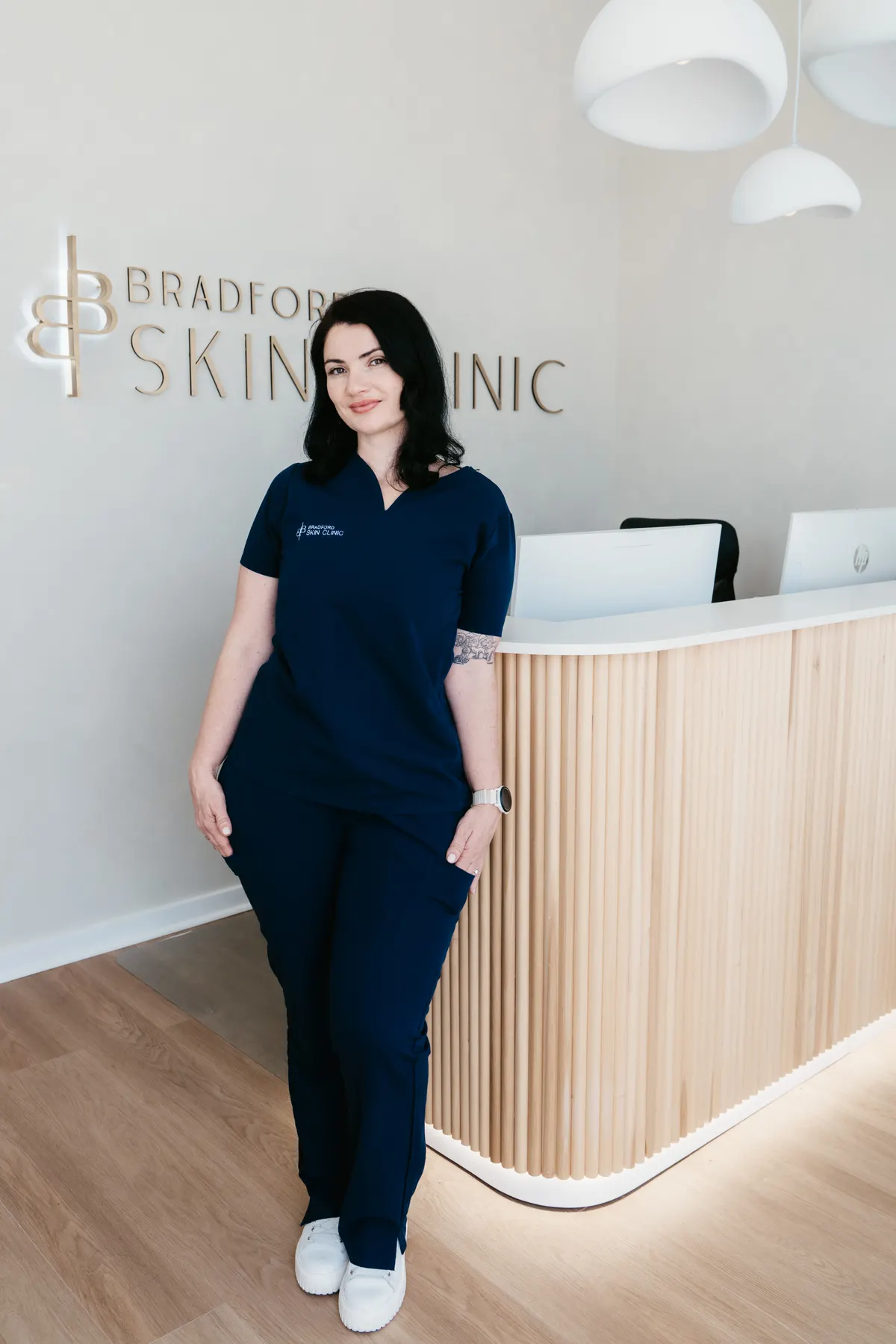
Alex Dinovich is Nurse Practitioner and Medical Director here. She is registered with the College
of Nurses of Ontario as 13564840, verifiable on the
public register.
What a directive gives you
Authority to perform the controlled act it names.
A written mechanism you can show.
A named provider accountable for authoring it.
What it does not cover
Anything the directive does not say.
Competence, which comes from training and practice.
Your own accountability to the College for your own decisions.
A directive covers what it says it covers.
Accountability under an authorizing mechanism is specific and bounded.
You remain accountable to the College of Nurses of Ontario for your own practice.
Alex Dinovich, NP. The authorising provider, not a name on a certificate.
The short answer
An RN in Ontario can inject. An RN in Ontario cannot decide on their own to inject.
That distinction is the whole subject. Your registration with the College of Nurses of Ontario establishes that you are a Registered Nurse; it does not, by itself, put cosmetic injection within your authority to initiate. The gap between what you may do and what you may start is closed by an authorizing mechanism issued by an authorized provider.
Everything below explains what that means in practice for an RN specifically.
Two controlled acts, every single time
Every cosmetic injection you perform engages two controlled acts under the Regulated Health Professions Act, 1991.
The first is administering a substance by injection. The second is performing a prescribed procedure below the dermis. Both are engaged by a neuromodulator. Both are engaged by a dermal filler. There is no version of aesthetic injecting where only one applies.
An RN may perform a controlled act when it has been authorized, but may not initiate it. Initiation means deciding, on your own authority, that this client should have this intervention. That decision is not yours to make as an RN.
Fillers are not a drug question, and this trips people up
Neuromodulators are prescription drugs in Canada. Dermal fillers are not. Health Canada regulates fillers as Class III medical devices, and as Class IV where the product is permanent.
A great deal of confusion follows from that fact, because people reason that if filler is not a prescription drug, no prescriber needs to be involved and therefore no authority is needed. The conclusion does not follow. Drug scheduling and controlled acts are two separate regimes. Filler escapes the first and is squarely inside the second.
Practically: for a neuromodulator you need a prescription and an authorizing mechanism. For filler you need an authorizing mechanism. You need the mechanism either way, and it is the mechanism that this page and this service are about.
What an authorizing mechanism looks like for an RN
Two forms.
A direct order names a client. An authorized provider assesses that person and orders the intervention for them. Precise, unambiguous, and impractical as the basis of a working aesthetic practice unless the provider is assessing every client.
A directive names circumstances rather than a person. It states the intervention, the client group it covers, the conditions that must be satisfied before you proceed, and the points at which you must stop and consult. Any client who genuinely meets those conditions is covered. Any client who does not is not.
Before you inject under a directive, three conditions have to hold at once:
The directive is current and genuinely covers this intervention for this client.
You have the competence to perform it on this person, including managing the foreseeable complications.
Nothing about the situation puts it outside the conditions written into the document.
If any of those fails, you stop. The directive is a boundary, not a permission slip.
Competence is yours and cannot be bought
A directive gives you authority. It does not give you skill, anatomical knowledge, or the judgement to recognise when something is going wrong.
The College holds you accountable for practising only within your competence, and competence is specific. Being competent with one facial area does not make you competent with another. Being competent with neuromodulators says nothing about your competence with filler, where the complication profile is entirely different and the consequences of getting it wrong are more serious.
This is also why “certified injector” is a phrase to be wary of. It is not a protected title, it does not appear in the Nursing Act, 1991, and no course in Ontario confers legal authority to practise. The protected titles are nurse, Registered Nurse, Registered Practical Nurse, Nurse Practitioner and Registered Nurse (Extended Class). If a training provider implies their certificate makes you legally able to inject, they are describing something that does not exist.
Why a Nurse Practitioner can be your authorizing provider
Ontario aesthetic clinics have historically gone looking for a physician for this role. That is convention rather than requirement.
A Nurse Practitioner is an autonomous provider. Alex Dinovich, Nurse Practitioner and Medical Director at Bradford Skin Clinic and Medical Spa, holds College of Nurses of Ontario registration 13564840 and can assess, diagnose, prescribe, issue direct orders and author directives in her own right. That covers every element an RN needs from an authorizing mechanism, including prescribing where a neuromodulator is involved.
There is a second, quieter advantage. She is regulated by the same College you are, reads the same standards you read, and writes directives in the College’s own vocabulary. Requirements differ by regulator, and the specifics of any particular arrangement are confirmed in conversation.
The rules are being reviewed
The College of Nurses of Ontario published a new Aesthetic Services practice guideline dated 3 July 2026, and has said it continues to review how authorizing mechanisms, including directives and delegation, are used in aesthetic practice.
So requirements may change. If you take one operational point from this page, take this one: a directive is a living document, and part of what a directorship arrangement should provide is somebody who notices when the ground moves and reissues your documents accordingly.
Where to start
If you are already trained and practising, the conversation is about your scope: what you inject, on whom, where, and what you are competent to manage when it goes wrong.
If you are not trained yet, authority is the wrong problem to be solving. Competence comes first, and we will say so.
Call 647-333-6805. Bradford Skin Clinic and Medical Spa, 444 Holland Street West, Unit 2, Bradford, Ontario. Directorship arrangements are available to RNs across the province.
Asked by nurses
Asked and answered.
Can an RN inject as an aesthetic treatment in Ontario without a doctor?
Yes, provided an authorized provider has given you an authorizing mechanism, and that provider does not have to be a physician. A Nurse Practitioner is an autonomous provider who can assess, diagnose, prescribe, issue direct orders and author directives, which covers everything the mechanism requires. What you cannot do is initiate the controlled acts yourself, regardless of how experienced you are.
What are the two controlled acts involved in cosmetic injection?
Administering a substance by injection, and performing a prescribed procedure below the dermis. Both are controlled acts under the Regulated Health Professions Act, 1991, and both are engaged every time you inject a neuromodulator or a dermal filler. An RN cannot initiate either one.
Do I need an authorizing mechanism for dermal filler if it is not a prescription drug?
Yes. Dermal fillers are Class III medical devices under Health Canada, Class IV if permanent, and they are not prescription drugs, but that is irrelevant to the question. The requirement comes from the controlled acts, not from drug scheduling. Injecting filler is still an injection and still a procedure below the dermis, so you still need the mechanism.
Can I own my own clinic as an RN and inject there?
You can own a business, but owning it does not give you the authority to initiate. The authorizing mechanism has to come from an authorized provider whether you are an employee, a contractor or the owner. Being the person who signs the lease has no effect on the Regulated Health Professions Act.
Does a training certificate make me a certified injector?
No, because there is no such thing in Ontario. There is no injector licence and no certificate confers legal authority. Certified injector and aesthetic injector are not protected titles. Nurse, Registered Nurse, Registered Practical Nurse and Nurse Practitioner are. Training gives you competence, which you must have, but authority is a separate question answered by an authorizing mechanism.
What has to be in my directive for it to actually protect me?
It must name the intervention, the clients it applies to, the conditions that must be met before you proceed, the circumstances in which it is valid, and the situations in which you must stop and consult. It must also be current. A directive that describes a practice you no longer have, or a guideline that has been superseded, is not doing the job you think it is.
What if a client in front of me does not fit the directive?
You stop, and you consult. That is not a failure of the arrangement, it is the arrangement working as designed. A directive covers a defined set of circumstances precisely so that the edge cases get escalated rather than absorbed. This is why the reachability of your authorizing provider matters more than the wording on any certificate.
Am I still accountable if I follow the directive exactly?
Yes. You remain accountable to the College of Nurses of Ontario for your own practice, your own competence and your own decisions. The authorizing mechanism gives you authority to act, and the authorized provider is accountable for the mechanism itself, but nothing transfers your professional accountability for how you carry out the intervention.
Sources
Where this comes from.
Everything on this page is drawn from the regulator, not from a
competitor's marketing. Read the originals rather than taking our word for any of it.
General information about Ontario regulatory requirements. Not
legal or regulatory advice. Nurses remain accountable to the College of Nurses of Ontario
for their own practice decisions.
Talk to us
Ask before you commit to anything.
Leave four details and Alex will come back to you directly. If what
you need is not something we do, we will say so and point you at whoever does.

 Written and reviewed by Alex Dinovich, NP, Nurse Practitioner and Medical Director at Bradford Skin Clinic & Medical Spa.
College of Nurses of Ontario registration 13564840, verifiable on the
public Find a Nurse register.
Last reviewed .
Written and reviewed by Alex Dinovich, NP, Nurse Practitioner and Medical Director at Bradford Skin Clinic & Medical Spa.
College of Nurses of Ontario registration 13564840, verifiable on the
public Find a Nurse register.
Last reviewed .