The CNO Aesthetic Services guidelineexplained by a Nurse Practitioner
The College of Nurses of Ontario published a practice guideline on aesthetic services in July 2026. It sets out what CNO expects of any nurse providing aesthetic care in Ontario: competence for the specific intervention, a valid authorizing mechanism where one is required, informed consent, emergency preparedness, documentation, and restraint in advertising.
Written and reviewed by Alex Dinovich, NP, Nurse Practitioner and Medical Director at Bradford Skin Clinic & Medical Spa.
College of Nurses of Ontario registration 13564840, verifiable on the
public Find a Nurse register.
Last reviewed .
At a glance
The short version.
InvestmentThis page is free to read. Directorship and training are quoted separately
The people who did this
Every injector here went through this pathway.
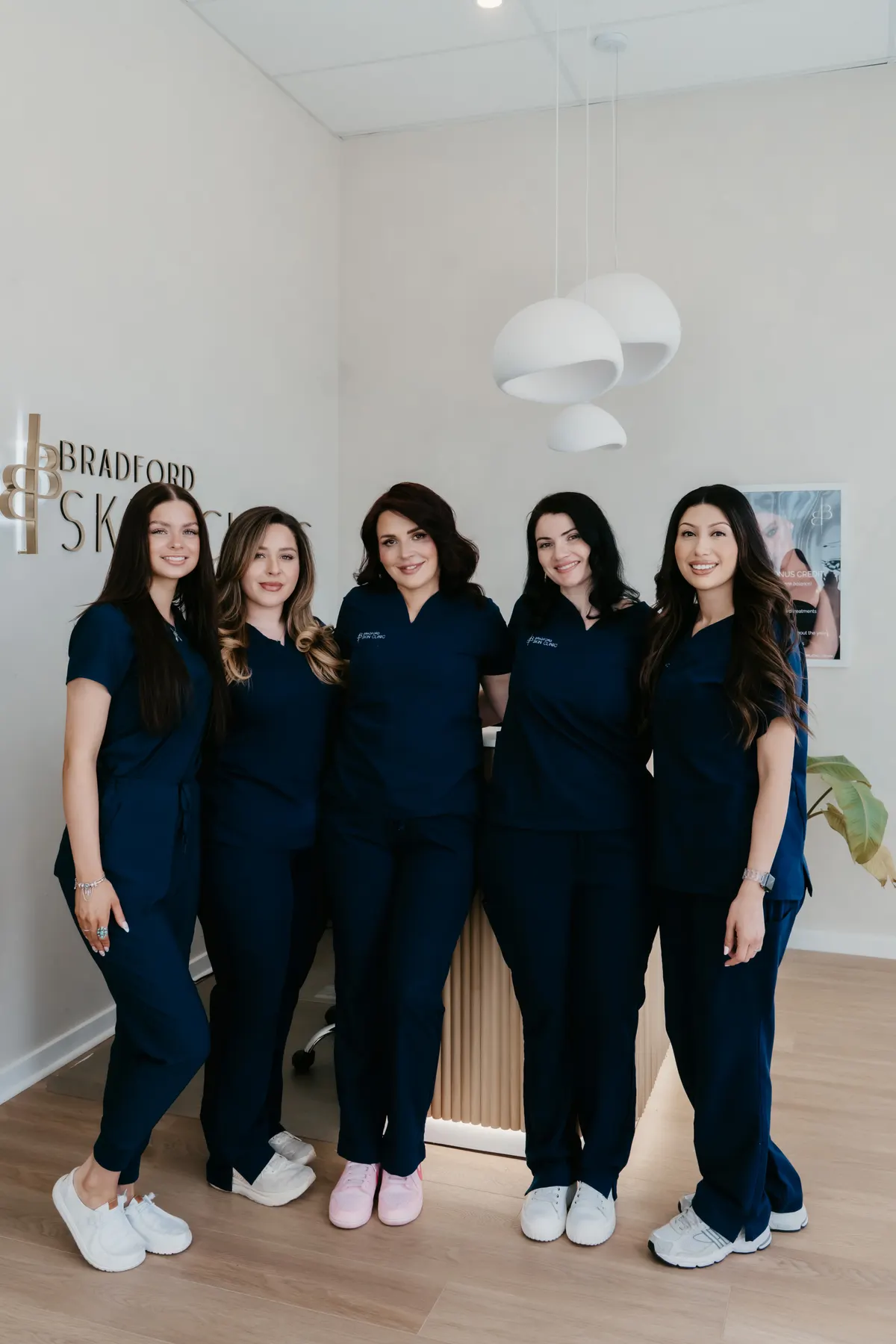
The team at Bradford Skin Clinic.
The detail
How this actually works.
Every injector here went through this pathway.
The College of Nurses of Ontario published a practice guideline on aesthetic services in July 2026, and if you are a nurse working in aesthetics you should read the document itself. This page is what it looks like to a practising Nurse Practitioner: what the guideline is, what it actually asks of you, what genuinely changed, and which parts are still open.
The short version is that the guideline creates no new licence, no new certificate and no new permission. It takes expectations that already applied to every nurse and states them in the setting where nurses in aesthetics actually work. That sounds modest. It is not, because expectations that are written down are expectations you can be measured against.
What a practice guideline is, and what it is not
A practice guideline explains how existing standards apply in a particular context. It does not create new law.
CNO issues practice standards, which set out mandatory expectations, and practice guidelines, which help nurses apply those standards to specific situations. The Aesthetic Services guideline is the second kind. It sits alongside the scope of practice standard, the guidance on directives, and the general practice standards, and it should be read with them rather than instead of them.
So nothing in it changes the Regulated Health Professions Act, 1991, the Nursing Act, 1991, or the controlled acts framework. There is still no injector licence in Ontario. No body certifies injectors. Your nursing registration remains the only licence involved.
Why CNO issued it
CNO issued the guideline because aesthetic nursing grew quickly in settings with little of the structure that surrounds nursing elsewhere.
Most nursing happens inside an organisation with policies, chart audits, a clinical educator and colleagues who notice. A great deal of aesthetic nursing happens in a small business, sometimes a business the nurse owns, sometimes a business owned by someone who is not a regulated professional at all. The standards always applied. The scaffolding that helps nurses meet them often did not.
That is the gap the guideline addresses. It is aimed squarely at the nurse working alone in a treatment room with a client, a product and a consent form nobody else has ever reviewed.
What the guideline asks of you
The guideline asks for six things, and none of them will surprise a nurse who has read the general standards.
Competence for the specific intervention. Not aesthetics in general, and not what you were competent in two years ago. The specific product, the specific site, this client.
A valid authorizing mechanism, where one is required. For an RN or RPN injecting, one is required.
Informed consent as a conversation. Realistic outcomes, foreseeable risks, alternatives, cost, and the option of doing nothing, discussed with someone who has the capacity to decide and is not being rushed.
Emergency preparedness proportionate to the risk. You can recognise the complications your treatments can cause, you have the supplies and the plan in the room, and you know your escalation route.
Documentation. Assessment, consent, product, lot, site, volume, technique, outcome, follow-up and anything that went wrong. Written as though someone else will read it, because someone else might.
Restraint in advertising. No guarantees of outcome, no comparative claims, no misleading impression of your qualifications or authority.
The regulatory position, stated plainly
In Ontario, an RN can administer a neuromodulator injection but cannot initiate it independently.
Injecting a neuromodulator or a dermal filler involves two controlled acts under the Regulated Health Professions Act, 1991: administering a substance by injection, and performing a prescribed procedure below the dermis. An RN requires an authorizing mechanism, such as a direct order or a directive, from an authorized provider such as a Nurse Practitioner or physician. (College of Nurses of Ontario, Aesthetic Services practice guideline, published July 2026.)
Two points that most coverage of this subject gets wrong are worth stating explicitly.
First, neuromodulators are prescription drugs in Canada. Dermal fillers are not. Health Canada regulates fillers as Class III medical devices, and as Class IV where the filler is permanent. The authority requirement for fillers therefore flows from the controlled acts, not from drug scheduling. A nurse who reasons that fillers are unregulated because there is no prescription to write has drawn the right conclusion about drug law and the wrong conclusion about their own practice.
Second, a course certificate is not an authorizing mechanism. A certificate is evidence of competence. Authority is a separate thing that comes from an authorized provider. The guideline does not change this, and it makes the distinction harder to fudge.
What actually changed, and what did not
Very little changed in law. A great deal changed in visibility.
What did not change: the controlled acts, the requirement for an authorizing mechanism, your accountability for your own competence, the absence of any injector licence, and the protected titles under the Nursing Act, 1991.
What did change: those expectations are now written down for aesthetics specifically. A directive written against a general understanding of the standards may not obviously fail, but it will look thin next to a document written against the guideline. Consent forms that list risks without recording a conversation now look thin too. If you have been practising carefully, the guideline is a confirmation. If you have been practising on inherited paperwork nobody has reviewed since you were handed it, this is the prompt to review it.
What it means for RNs, RPNs and NPs differently
The guideline applies to all three classes, but it lands differently on each.
Registered Nurses
An RN needs an authorizing mechanism to initiate, and the guideline gives you a clearer basis for asking whether yours is adequate. Read your directive against the six expectations above. Does it name the specific interventions you actually perform? Does it say what conditions must be met and when you must stop and consult? Is it current? If your director cannot answer those questions quickly, that is information.
Registered Practical Nurses
An RPN is in the same position on authority, and the guideline puts more weight on client selection. Your education is oriented toward clients whose conditions and outcomes are more predictable, so the question of whether this particular client is appropriate for you is a live clinical judgement each time, not a category you settled once.
Nurse Practitioners
An NP is an autonomous provider and can assess, diagnose, prescribe, issue orders and author directives. The guideline therefore lands on you twice: once as a practitioner, and once as the person other nurses are relying on.
If you author directives, the guideline is effectively a specification for them. It is also a reminder that authorship is ongoing. A directive is only live while the authorizing provider stands behind it, which means reviewing it, revising it when the nurse’s practice changes, and being reachable when a client does not fit.
One related change worth noting, because it affects how NPs are described: on 1 July 2026 CNO moved to a single Nurse Practitioner classification. The specialty certificates, Primary Health Care, Paediatrics and Adult, stopped being protected titles, and existing NPs transitioned without further examinations. An NP who trained in primary health care is still that, but the correct current styling is simply Nurse Practitioner.
Consent and emergency response
Consent for an elective cosmetic procedure carries a higher bar than consent for treatment somebody needs.
There is no medical necessity to fall back on. The client is paying, they have usually formed an expectation from photographs, and their satisfaction is bound up with an outcome you cannot fully control. The guideline expects the conversation to cover realistic outcomes, the foreseeable risks including the rare serious ones, alternatives, cost, and doing nothing at all. It expects the client to have capacity and to not be under pressure. Record the conversation, not merely the signature.
Emergency response is expected to be proportionate to the risk you have introduced. The practical test is uncomfortable but useful: if the worst foreseeable complication of the treatment you are about to perform happened right now, what would you do in the next ninety seconds, with what, and who would you call? If the answer involves fetching something from another building or looking something up, you are not prepared, and the fix is not a certificate.
Advertising: what a nurse may not say
The guideline places real limits on how a nurse advertises aesthetic services, and those limits bind you personally, not just your employer.
You may not guarantee an outcome. You may not use comparative claims that position you as better than other practitioners, which removes the entire category of best injector, top clinic and leading provider. You may not create a misleading impression of your qualifications or your authority, which is where the phrase certified injector becomes a problem: it implies a certification that no Ontario body issues. And you may not use the language of clinical necessity to sell an elective service.
This applies to what you post as much as to what you print. A nurse’s social media account is advertising.
The open question
CNO has said it continues to consult with health system partners and to actively review how authorizing mechanisms, including directives and delegation, are used in this area of practice.
That sentence is the most important thing on this page for anyone planning a business. It means the position is not settled. The current arrangement, in which most aesthetic nursing runs on directives authored by an authorized provider, is under active review by the regulator, and the outcome of that review is not knowable from here.
It is worth being precise about the two mechanisms, because the review names both. A directive authorizes you to perform a controlled act that is already within your profession’s scope, once the conditions are met. Delegation transfers an act from outside your profession’s scope to you. For a nurse injecting, both controlled acts are already within nursing scope, so the ordinary route is a directive.
The practical response is not to guess. It is to keep your documents in a state where they can be reissued quickly, to work with an authorizing provider who is watching for changes, and to be sceptical of anyone selling you a permanent solution to a question the College has openly said it is still considering.
Where to check, and where we fit
CNO Practice Support answers practice questions from nurses directly, and for anything specific to your own situation that is the right place to ask.
Obligations also differ by regulator. A physician who delegates is governed by the College of Physicians and Surgeons of Ontario; a Nurse Practitioner who authorizes is governed by CNO. Do not assume that a requirement you read about one applies to the other. Confirm the specifics rather than inferring them.
Alex Dinovich, Nurse Practitioner and Medical Director at Bradford Skin Clinic and Medical Spa, holds College of Nurses of Ontario registration 13564840 and authors directives for nurses across the province. If your current documents were written before July 2026, or you cannot tell whether they cover what you actually inject, that is a reasonable thing to have looked at, by us or by anyone competent to do it. Call 647-333-6805. We are at 444 Holland Street West, Unit 2, Bradford, Ontario.
Take it with you
Twelve questions before you inject.
Everything above, condensed to a checklist you can work through in
ten minutes: registration, controlled acts, your authorising mechanism, product class,
consent, insurance and advertising.
Leave an email and it opens straight away. We will not add you to anything, and if you
would rather just read it, the long versions are free and linked at the bottom of this
page.
Get the checklist
Four details and it opens on the next screen.
Thank you.
Here it is. It is also linked from the guides any time you want it again.
What is the CNO Aesthetic Services practice guideline?
It is a practice guideline published by the College of Nurses of Ontario in July 2026 that sets out the College's expectations for nurses providing aesthetic services. A practice guideline explains how existing standards apply in a specific context. It does not create a new licence, a new certificate or a new class of nurse, and there is still no injector licence in Ontario.
When was the CNO Aesthetic Services guideline published?
CNO announced it in a news release dated 3 July 2026, so the guideline is properly cited as published July 2026. If you are quoting a date in your own policies, cite the College's news release rather than a date read off a PDF cover, because extracted cover dates on the document have been reported inconsistently.
What changed in the new CNO guideline?
In terms of underlying law, very little. Nurses were already accountable for competence, consent, documentation and safe practice, and the controlled acts framework has not moved. What changed is the visibility. Expectations that were previously spread across general standards are now written down in an aesthetic context, which makes them concrete, teachable and much easier for an employer, an insurer or the College to audit against.
Does the guideline let RNs inject without a directive now?
No. An RN still cannot initiate the controlled acts involved in cosmetic injection and still needs an authorizing mechanism, such as a direct order or a directive, from an authorized provider such as a Nurse Practitioner or physician. Nothing in the guideline removes that requirement. If anything it makes the requirement harder to ignore, because it is now stated in the context where nurses actually work.
What is the difference between a directive and delegation?
A directive authorizes you to perform a controlled act that is already within your profession's scope, once the conditions in the document are met. Delegation transfers a controlled act that is outside your profession's scope from a member of another profession to you. For a nurse injecting a neuromodulator or a filler, both acts are already within nursing scope, so the usual route is a directive rather than delegation. CNO has said it continues to review how both are being used in this area.
Does my medical director have to be present when I inject?
That depends on what your authorizing mechanism says and on which regulator governs the person who signed it, and obligations differ by regulator. What is fixed is that the conditions written into your directive are binding on you. If it requires the author to be reachable, or requires a particular assessment before you proceed, that is a requirement of your practice. Confirm the specifics with CNO Practice Support rather than assuming.
Does the guideline change what nurses can advertise?
It reinforces expectations that already applied. A nurse advertising aesthetic services should not make guarantees of outcome, should not use comparative claims that place them above other practitioners, and should not create a misleading impression of their qualifications or authority. In practice that rules out phrases like best injector in Ontario, guaranteed results, and any implication that a course certificate confers legal authority.
Am I covered by insurance if I inject under a directive?
A directive is about authority, not about insurance, and the two are separate. You need professional liability protection in your own name that explicitly covers aesthetic practice, and you should confirm the wording rather than assume. You remain accountable to CNO for your own assessment, technique and decisions no matter whose signature is on the directive.
What does the guideline expect for emergencies?
It expects your emergency preparedness to be proportionate to the risk of what you are doing. In practical terms, that means you can recognise the complications your specific treatments can cause, you have the supplies and the plan to respond in the room rather than in another building, and you know your escalation route and when to use it. If you cannot manage the foreseeable complication of a treatment, you should not be performing that treatment.
Does the guideline apply to nurses who only do skin treatments, not injections?
Yes. The guideline addresses aesthetic services provided by nurses, not injections alone. Competence, consent, documentation and emergency preparedness apply whether you are injecting, using an energy-based device or delivering a chemical treatment. What varies is the risk profile, and the guideline expects your preparation to be proportionate to it.
Is anything about the guideline still unsettled?
Yes, and this is worth watching. CNO has said it continues to consult with health system partners and to actively review how authorizing mechanisms, including directives and delegation, are used in this area of practice. That is an open review, not a settled position, so requirements may change. Anyone telling you the rules are now fixed is offering you a certainty the College itself has not claimed.
Does the guideline replace the medical directives practice guideline?
No. The Aesthetic Services guideline sits alongside the existing CNO guidance on directives, the scope of practice standard and the general practice standards. Read them together. The aesthetic guideline tells you how the general expectations apply to this work; the directives guidance still governs what a valid directive has to contain and how it must be maintained.
Sources
Where this comes from.
Everything on this page is drawn from the regulator, not from a
competitor's marketing. Read the originals rather than taking our word for any of it.
General information about Ontario regulatory requirements. Not
legal or regulatory advice. Nurses remain accountable to the College of Nurses of Ontario
for their own practice decisions.
Talk to us
Ask before you commit to anything.
Leave four details and Alex will come back to you directly. If what
you need is not something we do, we will say so and point you at whoever does.


 Written and reviewed by Alex Dinovich, NP, Nurse Practitioner and Medical Director at Bradford Skin Clinic & Medical Spa.
College of Nurses of Ontario registration 13564840, verifiable on the
public Find a Nurse register.
Last reviewed .
Written and reviewed by Alex Dinovich, NP, Nurse Practitioner and Medical Director at Bradford Skin Clinic & Medical Spa.
College of Nurses of Ontario registration 13564840, verifiable on the
public Find a Nurse register.
Last reviewed .