Comparisons
Home hair removal devices vs professional lasers: what you are actually buying
Home devices are not a scam and we are not going to pretend they are. Here is what the published evidence actually shows, where a device is the sensible purchase, and where it is the wrong tool.
 Alex Dinovich, FNP-PHCClinically reviewed
| Aspect | Home device | Clinic laser |
|---|---|---|
| What it usually is | IPL, a broadband flashlamp firing many wavelengths at once | One wavelength chosen for your hair and your skin |
| Energy per pulse | Low by design, so it is safe to sell to anyone | High enough to require training and a controlled room |
| Who sets the dose | You do, from the booklet in the box | A trained clinician, settings signed off by our Medical Director |
| Darker skin tones | Sensor usually refuses to fire, or the device is not sold for you | Treatable with the right wavelength and settings, after assessment |
| Pale, grey or red hair | Will not work | Will not work |
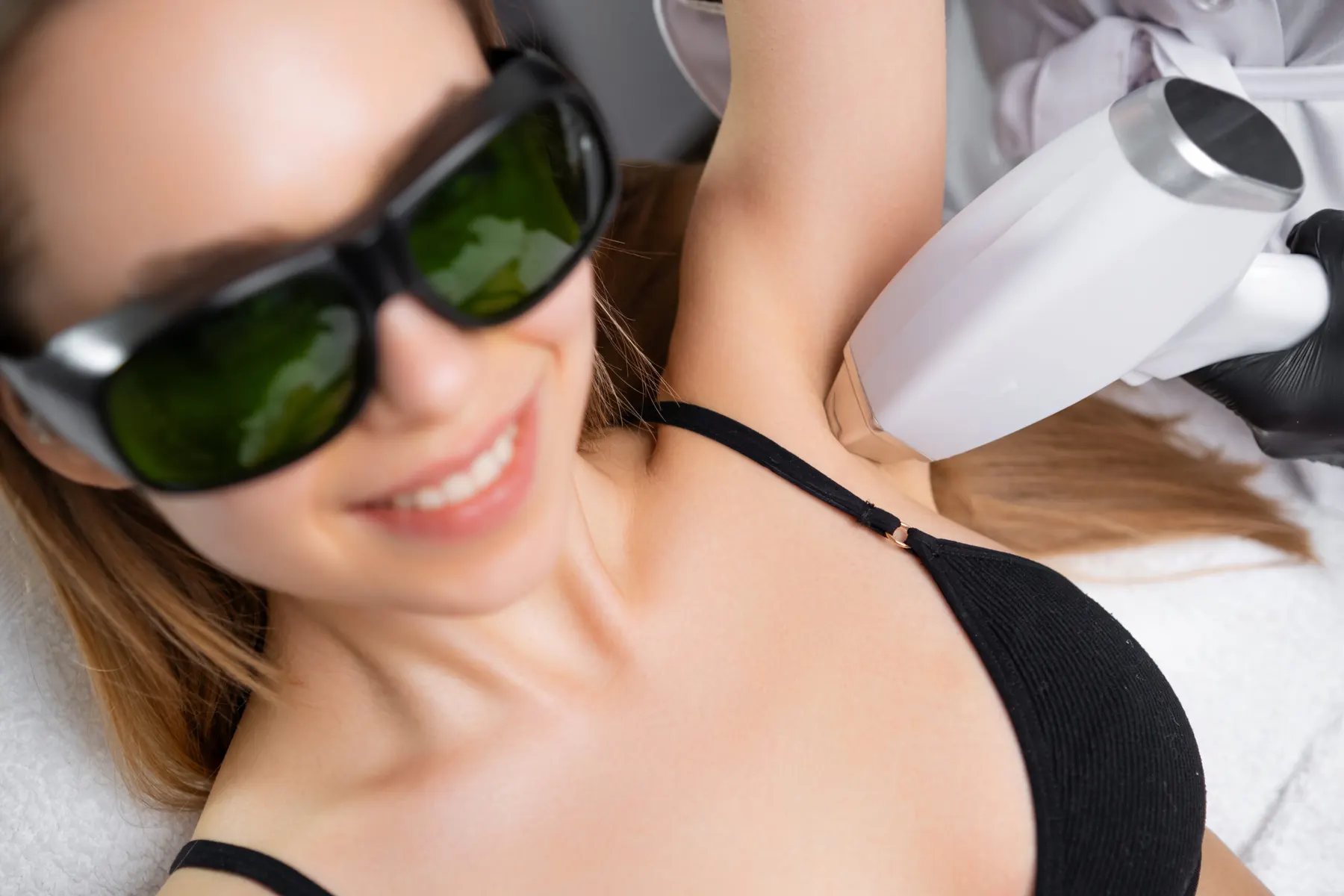
| Eye protection | Whatever came in the box, for that device only | Eyewear matched to the exact wavelength being fired |
| Time per area | A small window, so a full leg is an evening | A large handpiece, so a full leg is an appointment |
| If something goes wrong | You are the one who has to deal with it | You are assessed, and the plan changes |
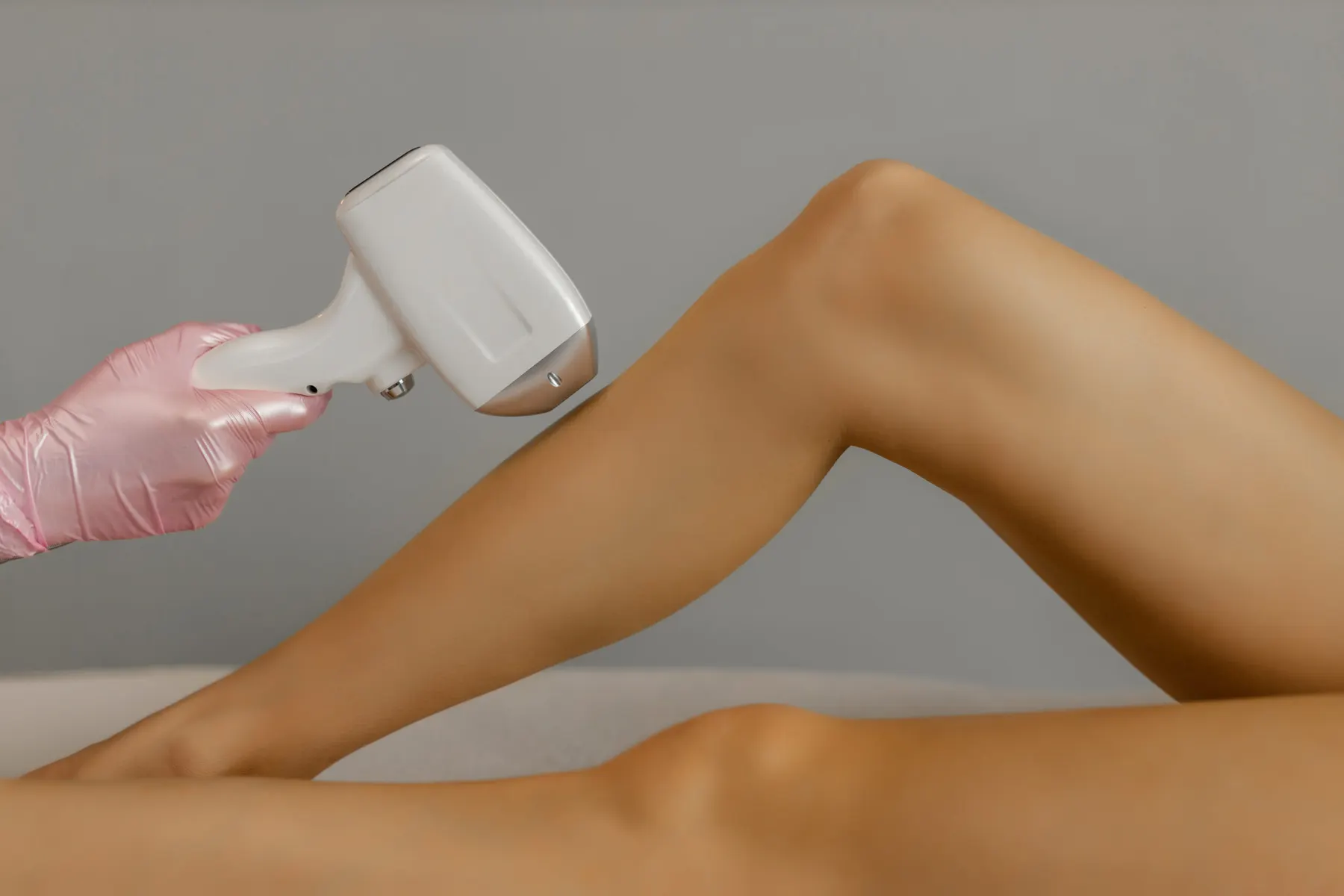
Home hair removal devices are not a scam, and we are not going to tell you they are in order to sell you a course. They deliver real, measurable hair reduction. They are also lower powered, slower, blind to who is holding them, and unavailable to a large group of people the sensor simply refuses to serve. What follows is the comparison with our interest stated plainly: we sell laser hair removal, and you should read every paragraph below with that in mind.
What the published evidence actually says
A 2012 systematic review of light-based home-use devices, published in the Journal of the European Academy of Dermatology and Venereology, found hair reduction figures ranging from 6% to 72% across the studies it assessed, with most of them following participants only to three or six months after treatment, and no randomised controlled trials available at the time. A 2022 review of home-use dermatology devices in Archives of Dermatological Research, covering 37 clinical trials of which 19 were randomised, did recommend home IPL for hair removal while flagging how little long-term efficacy and safety data exists for individual devices.
Read those two findings together and you get the honest position. Home devices work. The size of the result varies enormously, the follow-up is short, and the evidence for any one device in a shop is thinner than the packaging implies. That is a real treatment with a modest and uncertain ceiling, which is a very different thing from either “they do nothing” or “same results at home”.
Most home devices are IPL, which is not the same technology
Nearly everything sold for home use is IPL, intense pulsed light, which is a broadband flashlamp firing a spread of wavelengths at once through a filter. A laser emits a single wavelength. That matters because hair removal works by getting energy absorbed into the melanin in the hair shaft rather than into the skin around it, and one wavelength chosen for your hair and your skin tone does that job far more selectively than a spread of them.
A few home devices are genuine diode lasers rather than IPL, and they are better engineered for the task. They are still subject to the next problem.
The power is deliberately low, and that is the point
A home device has to be safe in the hands of someone who has read a pamphlet, in a bathroom, with no assessment and no supervision. The only way to make that true is to limit how much energy each pulse carries. Low energy is not a manufacturing failure or a cost saving. It is the condition on which the thing can be sold to the public at all.
The consequence is simply arithmetic. Less energy delivered per pulse means less damage to the follicle per pulse, which means more sessions, a longer schedule, and a lower ceiling on the final result. Everything a home device gives up in power, it is giving up on purpose, in exchange for being usable without a clinician.
The skin tone sensor is the part nobody mentions
Most home devices include a skin tone sensor that reads the area before firing, and most manufacturers do not sell their device for the deepest skin tones. If the sensor decides your skin is too dark, the device will not fire at all.
That is the device behaving correctly. It cannot change its wavelength, it cannot drop its settings based on an assessment, and in darker skin the surrounding melanin competes for energy meant for the hair, which is how burns and pigment changes happen. Refusing is the safe answer when there is nobody qualified in the room.
It also means the people who most need the technology chosen for them are precisely the ones the home route locks out. With the right wavelength, conservative settings, a patch test and a proper look at your Fitzpatrick type, darker skin can be treated in a clinic. If this is your situation, the home device is not a cheaper version of the clinic. It is a product that will not work for you at any price.
One limit is exactly the same in both places
If your hair is white, grey, red or very fair, neither a home device nor our laser will do anything useful, because there is no pigment for either to absorb. This is a biological limit, not a question of power or money, and no number of sessions and no device setting changes it. Electrolysis is the treatment that removes unpigmented hair. We do not offer electrolysis, which is exactly why we have no reason to be vague about this.
Eyes are the part to take seriously
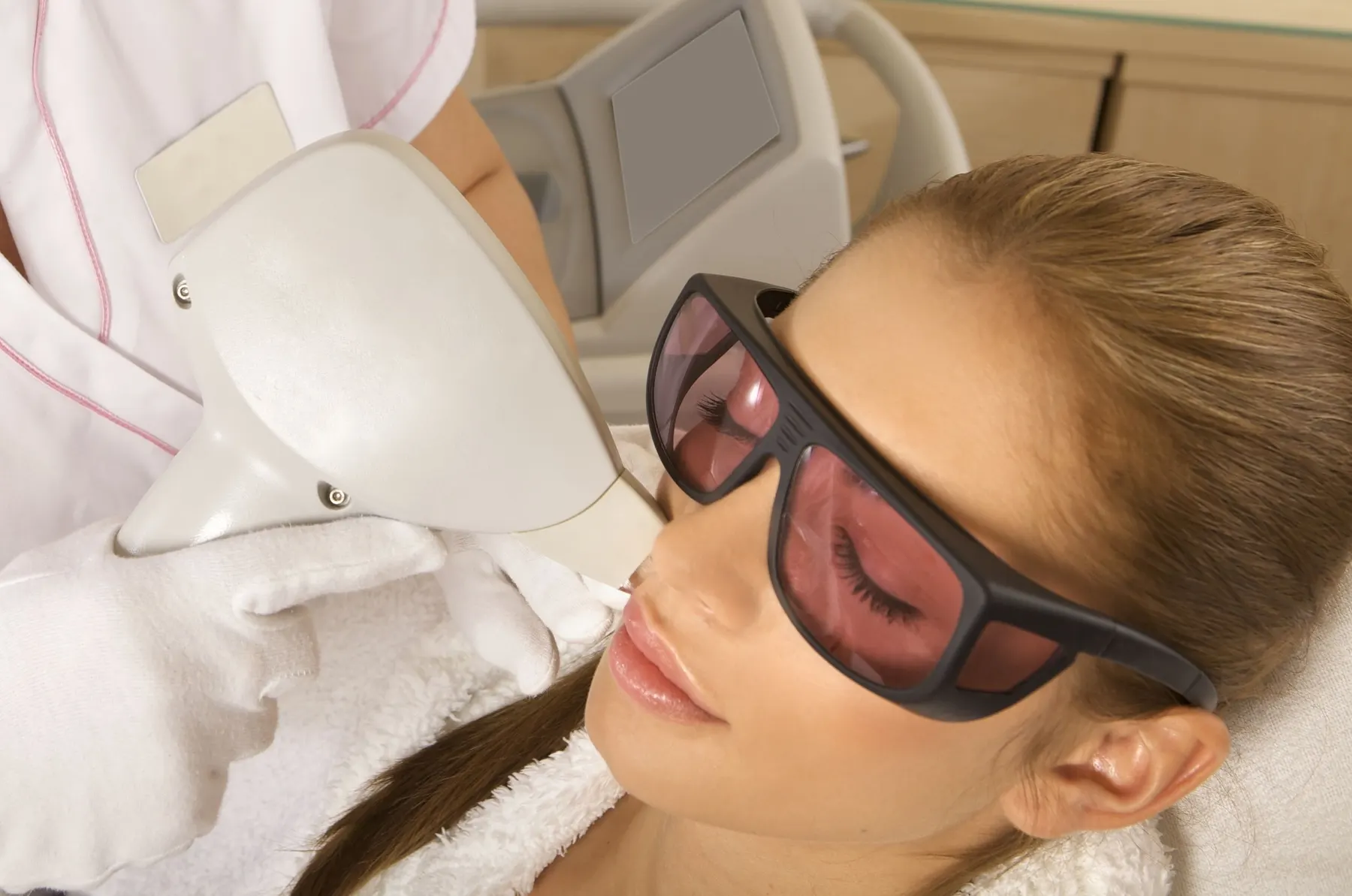
Health Canada’s Laser Hair Removal: Safety Guidelines for Facility Owners and Operators, first published in October 2011 with the Federal Provincial Territorial Radiation Protection Committee, treats eye protection as the single most important piece of protective equipment in a treatment room, and notes that the large majority of laser eye accidents happened because protective eyewear was not worn or the wrong eyewear was worn. It also makes the point that eyewear only protects against the specific wavelength it is built for. Goggles for one device are not goggles for another, and sunglasses are not goggles at all.
In a clinic, that is handled by someone whose job it is. At home it is handled by you, holding the device yourself, often in a mirror, frequently on the face. Use the protection that came with your device, use it every time, follow the manufacturer’s instructions on which areas are permitted, and do not go above the cheekbone. The risk here is low if you are careful and permanent if you are not.
The room, the training and the paperwork
The same Health Canada guidance describes what sits behind a clinic treatment: a controlled treatment area, warning signage, documented safety training covering hazards, control measures and patient care, maintained protective equipment, and advice that facilities buy only devices holding an active Canadian medical device licence, which anyone can check on the MDALL database.
Two honest caveats. First, that federal guidance is voluntary, and the rules that bind actually vary by province and territory, so none of it is automatic. Second, that means the right question is never “clinic or home”, it is “who is holding the handpiece and what are they trained in”. Ask any clinic, including ours. If a clinic will not tell you who is treating you, what device they are using and who signed off your settings, the building does not make it safer than your bathroom.
Nobody at home asks why the hair is there
A device bought online cannot notice that your hair growth changed pattern over eighteen months, that it arrived in a distribution that suggests a hormonal driver, or that polycystic ovary syndrome is worth ruling out with your family doctor. It cannot tell you that a course will need maintenance for that reason, and it will not warn you off treating while you are pregnant or while a photosensitising medication is in your system.
That consultation is a real part of what a clinic visit is, and it is the part people forget they are buying. It is also the part we would rather you got somewhere, from somebody, even if that somebody is not us.
The money, with our real numbers
Here is where the comparison becomes concrete, using our current published prices.
An upper lip is $49 for a single session and $209 for a course of six. A home device bought once, used for years, can genuinely come out ahead on a small area like that, and we would rather say so than pretend otherwise.
Underarms, or bikini, sit at $79 for one session and $319 for six on our women’s rate card; the men’s card prices the same areas differently. That puts a complete course in the same range as a mid-priced home device, done by someone trained, in a fraction of the total time.
A full leg is $309 for one session and $1,399 for six. No home device costs that. What it costs instead is an evening every couple of weeks for months, pressing a small window over the whole surface of both legs, at a fraction of the energy per pulse, with a lower final result. That is a legitimate trade for some people. It is a trade, not a saving.
Our full rate tables by area, for women and for men, are on the laser hair removal page, and packages carry 20% off three sessions, 30% off six and 40% off ten.
When we would tell you to buy the device
If the area is small, your skin is light and your hair is dark, your budget is tight, and you know yourself well enough to be confident you will actually keep to a schedule for months, buy the device. It is a reasonable purchase and it will do something.
The same goes for maintenance. Once a clinical course has finished and the bulk of the hair is gone, a home device is a sensible way to stay on top of what comes back, and that is probably its single best use.
When it is the wrong tool
Darker skin, where the device will refuse you or should. Anything close to the eye. Large coarse areas, where the time cost is enormous and the energy is weakest relative to the job. A pattern of hair growth that changed recently or arrived somewhere new, which deserves a diagnosis before it deserves a gadget. And any situation where you can feel yourself wanting to run the device hotter than the instructions allow, because that impulse is how people get burns at home.
Our position, stated plainly
Buy the home device for a small area, a tight budget, or maintenance after a course, and we will tell you that to your face at a consultation. Book a clinic if the area is large, if your skin is deeper than the sensor will accept, if the hair is coarse and stubborn, or if you want somebody accountable for the settings and the outcome. If your hair has no pigment, book neither of us and find an electrologist.
What you are buying from a clinic is not a better bulb. It is a wavelength chosen for you, energy high enough to do real work, somebody trained to decide how much of it you get, and a person to answer for it if your skin reacts.
Written at Bradford Skin Clinic & Medical Spa, 444 Holland St W, Unit #2, Bradford, Ontario. We provide laser hair removal and do not provide electrolysis, and we do not sell home hair removal devices. Prices quoted are current at the date of publication. Clinically reviewed by Alex Dinovich, FNP-PHC, Nurse Practitioner and Medical Director.
03 · Accountability
Written here.
Checked here.
This guide was written by Bradford Skin Clinic and clinically reviewed by Alex Dinovich, FNP-PHC before it was published.
- Published
- Last updated
- Category
- Comparisons
A guide is general and your face is not. Nothing here replaces an assessment in the room, which is free and happens before anything is booked.
04 · From reading to the treatment room
What this looks
like in practice.
Published prices are starting prices, confirmed at your consultation. Where nothing is published, the dose and the plan decide the price rather than a menu.
- Laser hair removal from $30
Every injectable here is placed by a licensed nurse, and every plan is signed off by our Medical Director. The consultation is free and comes before anything is booked.

05 · Who performs these treatments
The people behind
the writing.
Nobody here injects without a nursing licence. The guides on this site are written by the same people who carry out the treatments they describe.







06 · Asked and answered
The questions
that follow.
Do at-home laser hair removal devices actually work?
Yes, within limits. A 2012 systematic review in the Journal of the European Academy of Dermatology and Venereology found real hair reduction from home light-based devices, but reported results ranging from 6% to 72% across the studies it examined, with most follow-up stopping at three to six months. So the honest answer is that they produce a genuine but modest and variable reduction, and the long-term picture is far less documented than the marketing suggests.
Is at-home IPL the same as clinic laser hair removal?
No. Most home devices are IPL, which is a broadband flashlamp emitting many wavelengths at once, while a clinic laser emits a single wavelength chosen for your hair and skin. Home devices are also deliberately built at a much lower energy so they can be sold without an operator. Both of those differences reduce how much work each pulse does.
Can I use a home hair removal device on dark skin?
Usually not, and that is the device refusing rather than failing. Most home devices carry a skin tone sensor and most manufacturers do not sell them for the deepest Fitzpatrick types, because the device cannot adjust for the melanin competing for its energy. A clinic can treat darker skin with the correct wavelength and conservative settings after assessing you. If that is your situation, the home route is closed and the clinic route is not.
Is a home device safe to use on my face?
Treat the face as the high-risk area, because it is. Eye injury is the serious hazard with any light-based hair removal, and Health Canada's own guidance for laser hair removal facilities identifies eyewear as the single most important piece of protective equipment, noting that most laser eye accidents happen because protection was not worn or was the wrong type. Follow the manufacturer's instructions exactly, never use a device above the cheekbone, and never substitute sunglasses or borrowed goggles.
Will a home device work on grey, white or blonde hair?
No, and neither will ours. Both technologies work by being absorbed into the pigment in the hair, so hair with little or no pigment gives them nothing to target. This limit is identical at home and in the clinic. Electrolysis is the treatment that works on unpigmented hair, we do not offer it, and we will tell you so rather than sell you a course.
Is a home device cheaper than a course at a clinic?
For a small area over several years, often yes, and we would rather say so than pretend otherwise. For a large area the comparison is less about money than about how many evenings you want to spend: a home device is one purchase, but it is slower, weaker per pulse, and entirely dependent on you keeping a schedule for months. Our laser hair removal page publishes the full rate tables by area, for women and for men, so you can put the real figure for your own area against the price of a device.
Can I use a home device between clinic sessions?
Ask us first, and in most cases we will say wait. Running a second light source over an area we are already treating makes it impossible to tell which device caused a reaction, and it changes the skin we are basing your settings on. Home devices are a much more reasonable idea for maintenance once a course has finished.
Does a home device hurt less?
Generally yes, because it is firing less energy, and that is the whole trade. Lower energy means less sensation, less risk in untrained hands, and less effect per pulse. Comfort is not a sign that a device is working better.