
MolesWhat it is, and what we can do about it.
A mole, or melanocytic naevus, is a benign cluster of pigment-producing cells in the skin, but because moles can occasionally become malignant, any mole that is new, changing, asymmetrical, irregularly bordered, multi-coloured, growing, itching or bleeding requires assessment by a physician or dermatologist rather than cosmetic removal.
- Nurse-practitioner-led
- Plan before treatment
- 444 Holland St W, Bradford
02 · The honest version
The honest version
of moles.
How we assess moles, why we do not remove pigmented lesions cosmetically without medical clearance, and when to see a doctor instead.
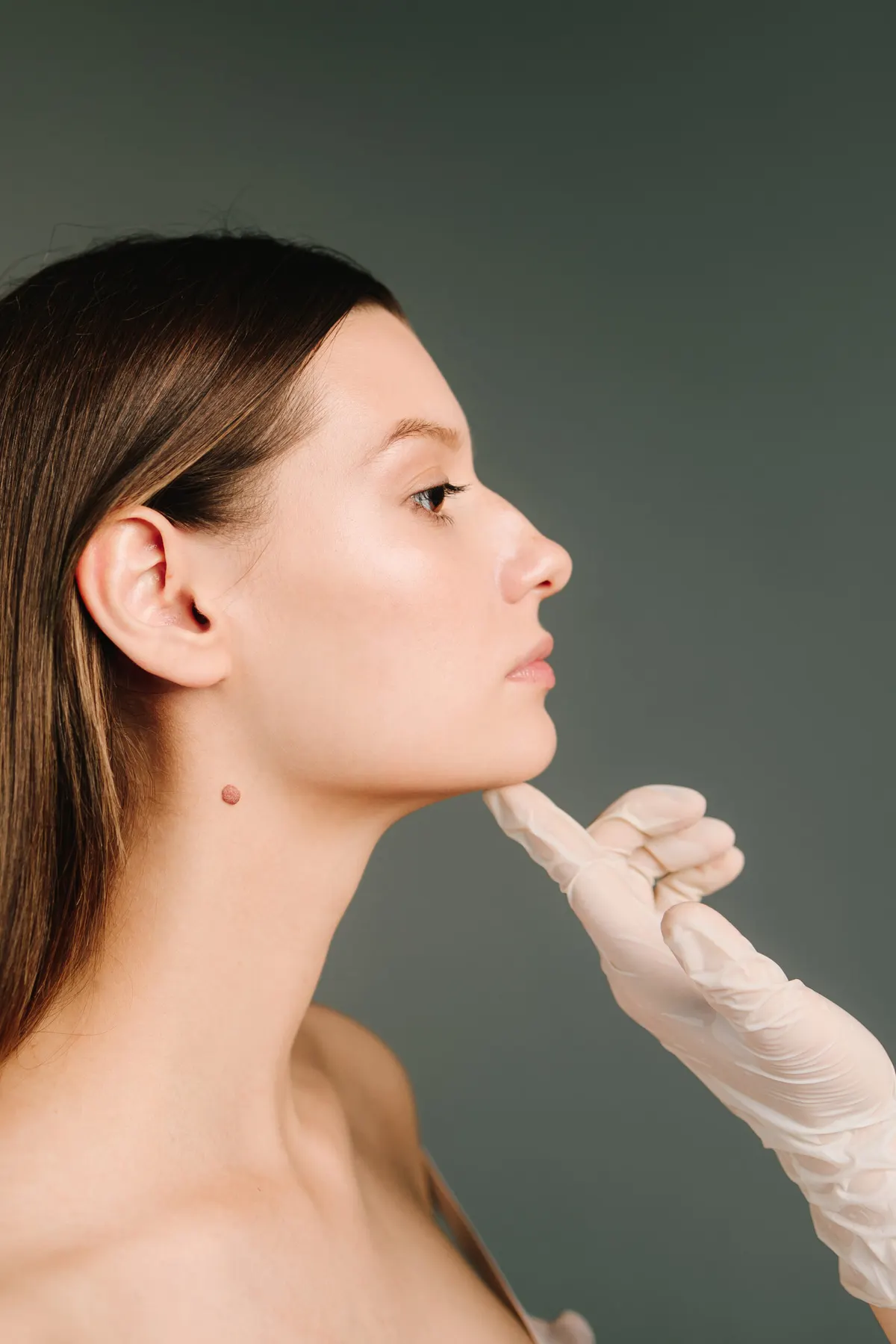
- -A mole that has changed shape, size or colour
- -Asymmetry, where one half does not match the other
- -An irregular, blurred or notched border
- -More than one colour within a single mole
- -A mole that has begun to itch, crust or bleed
- -A new pigmented spot appearing in adulthood
Every face is different. This page is the general picture. What is actually happening on your skin is something a nurse should look at up close, in clinic light, before anyone recommends a treatment.
Does it get worse? That depends on the concern and on you. It is a reason to start early, not a reason to panic - and we will tell you plainly where you are rather than where a treatment plan would be easiest to sell.
Our position, stated plainly
Bradford Skin Clinic & Medical Spa does not remove pigmented lesions cosmetically without prior medical assessment.
That is a deliberate policy, not a limitation of our equipment. A mole is a collection of melanocytes, the pigment-producing cells of the skin, and while the overwhelming majority of moles are entirely benign and will remain so, a small proportion of pigmented lesions are or become melanoma. Melanoma is highly treatable when found early and dangerous when found late.
Cosmetic removal methods destroy tissue. If a lesion is destroyed rather than excised intact, there is no specimen for a pathologist to examine. The visible problem disappears, the patient reasonably concludes it has been dealt with, and a diagnosis that depended on that tissue is lost. That is an unacceptable trade for a cosmetic result, and it is why our answer is assessment and referral rather than removal.
What we do instead
We look properly. If a mole concerns you, or if there is a pigmented lesion in an area you have asked us to treat, we will examine it as part of your consultation and tell you honestly what we see.
We do not diagnose. We are a medical aesthetics clinic. We do not diagnose skin cancer, and we will not offer reassurance we are not qualified to give. Telling you a lesion looks fine when we cannot know that would be worse than useless.
We refer. If anything about a lesion is not clearly benign, we will recommend assessment by a physician or dermatologist and help you understand what to ask for. In Ontario, your family physician is the usual route, and a walk-in clinic can assess and refer if you do not have one.
We treat around it. Cosmetic treatments in an area containing a pigmented lesion are generally worked around rather than over it. Where we are not comfortable proceeding, we will say so and explain why.
When to get a mole checked
The single most important feature is change. A mole that has looked the same for many years is far less concerning than one that is doing something new.
The ABCDE checklist is a practical way to think about it:
- Asymmetry. One half of the lesion does not mirror the other.
- Border. The edge is irregular, notched, blurred or poorly defined.
- Colour. There is more than one shade within the lesion, or an unusual colour.
- Diameter. Larger lesions warrant closer attention, though small melanomas exist.
- Evolving. Any change in size, shape, colour, elevation, or the onset of itching, crusting or bleeding.
A lesion that looks obviously different from your other moles is also worth having seen, regardless of whether it ticks any of the boxes above. Do not wait for a change to become dramatic before acting on it.
Sun exposure and risk
Cumulative and intermittent intense ultraviolet exposure are established risk factors for skin cancers, including melanoma. Daily broad-spectrum sun protection, avoiding tanning beds, and being sensible during peak summer hours in Ontario are all worthwhile regardless of what cosmetic treatments you do or do not have. If you have a lot of moles, a family history of melanoma, or fair skin that burns easily, periodic skin checks with your physician are a sensible habit.
If you came here looking for mole removal
We understand that is not the answer you were searching for, and we would rather be useful than convenient. Take the lesion to a physician. If it is benign and you still want it gone, it can be removed properly by someone who can also have it examined. That is a better outcome for you than a quick cosmetic fix from us, and it is the only version we are prepared to offer.
You are still very welcome here for the many things we can help with, and if you would like us to look at a lesion and tell you what we think, book an assessment and we will be straight with you.
03 · What actually happens
Come in as you are.
Nobody here will
react to your skin.
If you have been putting this off, this section is for you. A consultation costs you nothing and commits you to nothing - you are allowed to walk out having booked absolutely nothing.
- Sheli greets you at the front desk
She is the one who answers the phone and the texts, so you will already have spoken to her. No clipboard interrogation in the waiting room.
- A nurse looks at your skin properly
In clinic light, up close, with your makeup off if you are wearing any. This is the part people dread and it takes about a minute.
- We ask about the history, not just the face
When it happens, what you had noticed before it happened, what you have already tried and what made it worse. Bring your current products if it is easy.
- You get a written plan and a real price
What we would do, in what order, and what it costs - including the option of doing nothing yet. If a treatment is wrong for you, we say so here, not after.
- You decide in your own time
Nothing is booked in the room unless you want it booked. No deposit, no pressure, no offer that expires on Friday.
Always so kind and personal. Took the extra time to make sure I was comfortable.
04 · Straight answers
Moles, asked
and answered.
The questions people actually ask us on the phone, answered the way we answer them on the phone.
Do you remove moles at Bradford Skin Clinic?
We do not remove pigmented lesions cosmetically without prior medical assessment. A mole is made of pigment-producing cells, and a small proportion of pigmented lesions are or become malignant. Removing one cosmetically destroys the tissue that a pathologist would need in order to examine it, which can delay a diagnosis that matters. Our role is assessment, clear advice and prompt referral.
Why does cosmetic removal of a mole carry a risk?
Because it removes the evidence. If a lesion is destroyed by a cosmetic method, there is no intact specimen to send for histopathology, and an early melanoma can be missed while the patient believes the problem has been dealt with. Any lesion that requires removal for medical reasons should be excised by a physician and examined under a microscope.
What is the ABCDE rule?
It is a widely used checklist for identifying moles that need medical assessment. A is for asymmetry, where one half does not match the other. B is for an irregular or poorly defined border. C is for colour that varies within the lesion. D is for diameter, with larger lesions warranting closer attention. E is for evolving, meaning any change in size, shape, colour, or the onset of itching or bleeding. Any one of these is a reason to see a doctor.
Should I be worried about a mole that has always been there?
A stable mole that has looked the same for years is far less concerning than a new or changing one, and most people have a number of entirely ordinary moles. The feature that matters most is change. If you notice something evolving, do not wait for it to become obvious before having it looked at.
Who should I see about a mole in Ontario?
Start with your family physician, who can assess the lesion and refer you to a dermatologist if needed. If you do not have a family doctor, a walk-in clinic can assess it and initiate a referral. Skin assessment for suspected malignancy is a medical service and is handled through the health system rather than through a medical aesthetics clinic.
What if my mole is just annoying rather than concerning?
That is a reasonable thing to want dealt with, and it is still a conversation to have with a physician rather than with us. A mole that catches on clothing, is repeatedly nicked while shaving or is cosmetically bothersome can be removed, but it should be removed by someone who can send it for pathology. We will happily tell you what we see and point you in the right direction.
Can you tell me whether a mole is cancerous?
No, and neither can anyone without appropriate medical training and, ultimately, a tissue diagnosis. We do not diagnose skin cancer. What we will do is look carefully at any pigmented lesion in an area we are asked to treat, tell you plainly if something looks like it warrants medical review, and recommend you get it seen.
Will you still treat the skin around a mole?
In many cases yes, with care. Cosmetic treatments are generally worked around a pigmented lesion rather than over it. If a lesion in the treatment area has not been medically cleared and we are not comfortable proceeding, we will tell you and we will explain exactly why rather than quietly declining.
Where this comes from
Check it yourself.
We would rather you did not take our word for any of this. These are the sources behind what is written above, and none of them are ours.
05 · Often confused, often alongside
Not sure it's
moles?
Concerns are regularly mistaken for one another - and they rarely turn up entirely alone. These are the ones that sit closest to it.

06 · The next step is small
Let a nurse look
at it properly.
A moles consultation costs you nothing and commits you to nothing. You will leave knowing what your skin is doing, what we would do about it, and what it would cost - whether or not you book anything.
- Address444 Holland St W, Unit #2
Bradford, ON L3Z 0G1 - Phone647-333-6805
- Emailinfo@bradfordskinclinic.com
- HoursMon, Tue, Thu 9am-7pm
Wed 9am-5pm
Fri, Sat 9am-4pm
Sun Closed
Bring three things. Whatever you are currently putting on your face, a rough idea of when it is at its worst, and any questions you have written down. That is genuinely all the preparation we need.
Makeup is fine either way. If it is easier to arrive with it on, arrive with it on - there is a mirror and a cleanser in the room.