Treatments
Does PRP Work for Hair Loss? The Honest Version
The answer depends almost entirely on one thing, and it is not the clinic you choose or the machine they use. It is whether the follicles are still there. This is how to work that out before you spend anything.
 Alex Dinovich, FNP-PHC, Nurse Practitioner and Medical DirectorClinically reviewed
| Aspect | PRP for hair | Hair transplant |
|---|---|---|
| What it is | Your own platelets, injected across the scalp | Surgery, moving follicles from the back of the head |
| What must still be there | Living follicles that are thinning | A donor area with healthy follicles |
| What it does for a smooth, bald area | Nothing. There is no follicle to support | Moves follicles into it |
| When you judge it | Months later, against photographs taken on day one | Months later, once the grafts have grown through |
| Is it permanent | No. It is maintained or it fades | The moved follicles are permanent, the rest of the scalp carries on ageing |
| Is it surgery | No | Yes |
| Offered here | Yes, $599 a session | No. We refer |
Most pages about PRP for hair answer a different question from the one people are asking. They explain what platelet-rich plasma is. The actual question is whether it will work on your head, and the honest answer depends almost entirely on one thing.
Not the clinic. Not the machine. Whether the follicles are still alive.
The distinction that decides it
Pattern hair loss does not switch follicles off. It shrinks them. Over years, affected follicles produce progressively finer, shorter, weaker hairs, until what they make is barely visible. That process is called miniaturisation, and a miniaturised follicle is still a living follicle.
PRP is a treatment for that stage. It is intended to support follicles that are still there and still working badly.
What it cannot do is create a follicle. Once an area has gone fully smooth and the follicular openings have closed, there is nothing to support, and injecting plasma into it does not change that. This is why two people can have the same treatment, with the same product, from the same injector, and get completely different outcomes. They were not at the same stage.
So the useful question is not “does PRP work”. It is “is there anything left on my scalp for it to work on”.
How to look at your own scalp
You can get a reasonable sense of this yourself before anyone sells you anything.
Good light, a mirror, and a second mirror or a phone camera for the crown. What you are looking for is whether the thinning area still has fine, wispy hairs growing in it, or whether it is bare skin. Fine hair means living follicles. Shine with no visible openings at all usually means they are gone.
Compare the thinning area with the back and sides, which in pattern loss are usually unaffected. That comparison tells you more than the thinning area alone.
This is a rough test and not a diagnosis. We look at the scalp properly at the consultation, which is free, and we will tell you plainly if what we see is a transplant conversation rather than a PRP one.
What the evidence supports, and what it does not
PRP has been studied for pattern hair loss for well over a decade, and the research is genuinely mixed in quality. Study sizes are often small, preparation methods differ between clinics, and what counts as a result is not measured the same way twice.
Read across it carefully and the pattern is this. The strongest and most consistent signal is reduced shedding and stabilisation: hair that was falling, falling less. There is reasonable support for some increase in hair density and calibre in people treated at the right stage. The weakest claim, and the one marketing leans on hardest, is dramatic regrowth.
We are not going to publish a success rate. Any single percentage you see for PRP is pulled from one study with one protocol, and it will not tell you what your scalp will do.
Stabilisation is worth taking seriously, though. For progressive hair loss, holding ground is a real outcome. It just does not photograph well, which is exactly why photographs on day one matter: without them, a year later, nobody can tell the difference between “it held” and “nothing happened”.
Five reasons PRP would be the wrong purchase
This is the part that should come before any price.
Iron deficiency. Low ferritin is a common and frequently missed cause of diffuse shedding, particularly in women. It is treatable, and treating it is cheaper than treating a scalp.
Thyroid disease. Both under and over active thyroid cause hair loss. Again, treatable, and again, the hair often recovers once the thyroid is managed.
Telogen effluvium. A large synchronised shed, usually two to four months after a trigger: illness, surgery, childbirth, a crash in weight, a new medication, a period of serious stress. It looks alarming, it is diffuse rather than patterned, and it usually recovers on its own. Buying a course of injections while this is resolving means paying for something that was going to happen anyway.
A medication you are already taking. Several common ones cause shedding. Worth reviewing before anything else.
Autoimmune alopecia. Patchy, well-defined, sometimes sudden loss is a different condition with a different treatment pathway, and some forms scar. Scarring alopecia is a reason to see a dermatologist, not a reason to book PRP. Our page on alopecia covers the distinction.
Two of those recover without treatment. Two are fixed by treating something else entirely. That is why the assessment comes first here, with our Nurse Practitioner, who can order and interpret the relevant blood work rather than sending you back to start again.
When a transplant is the answer
If the area that bothers you is smooth, a transplant is the treatment that addresses it, because it moves follicles into a place that no longer has any.
We do not perform hair transplants and we do not take a referral fee for saying this. What we would add, from people who come to us afterwards, is that a transplant moves follicles and does not stop the rest of the scalp ageing, which is why surgeons often discuss maintaining the hair you still have alongside it.
Women, specifically
Female pattern loss is common and gets less attention than it should. It usually shows as a widening part and diffuse thinning over the top, with the hairline intact, rather than the receding pattern people picture.
The principle is the same. What differs is that the workup matters more, because iron, thyroid, hormonal and postpartum causes are all common, and more than one can be running at once. A plan built without that workup is a guess.
What a sensible plan looks like here
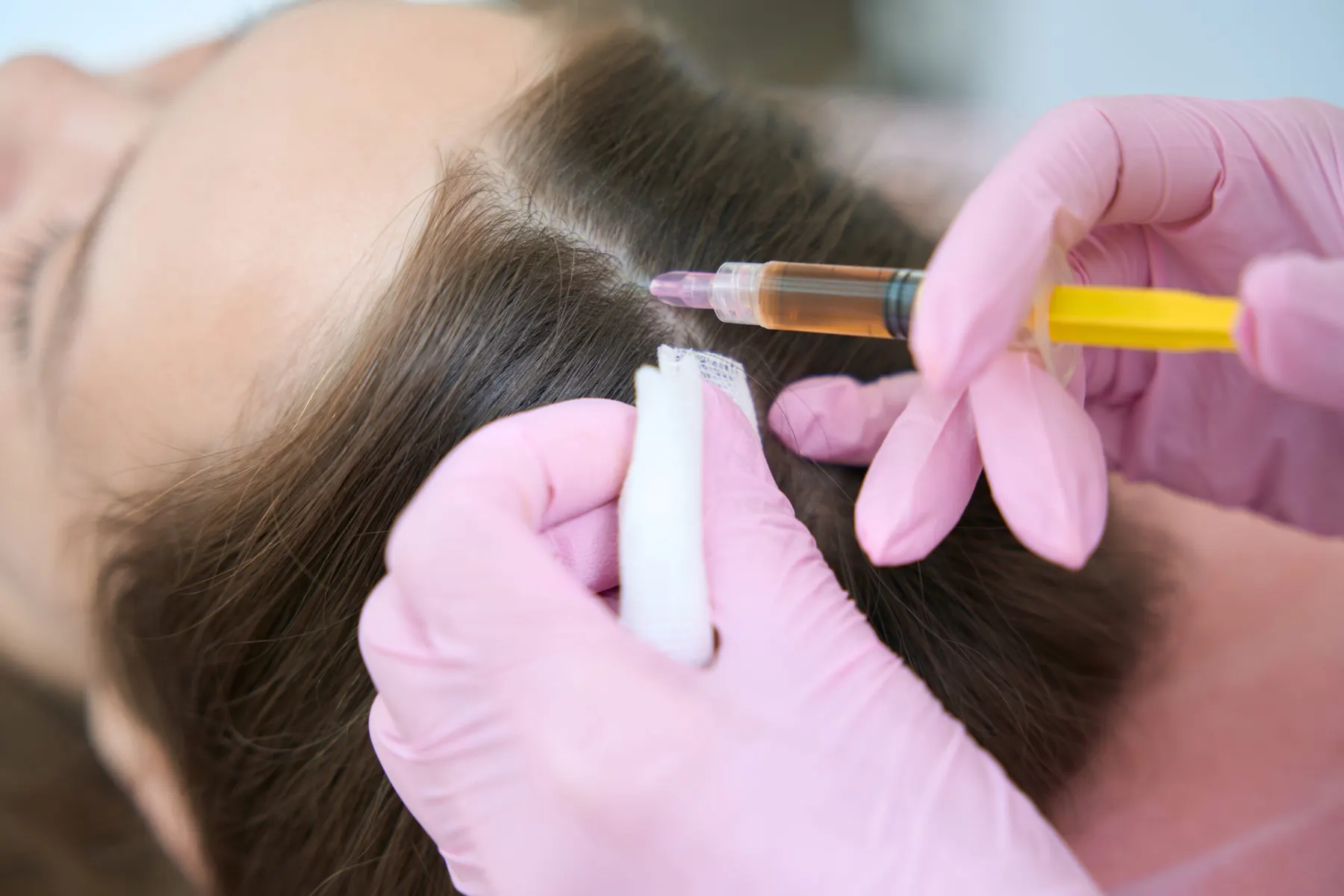
An assessment first, with blood work where it is indicated. Photographs at the first appointment, taken in fixed conditions, because they are the only honest way to judge this later. Then PRP if the stage is right, at $599 a session, with the course planned and quoted at the consultation rather than guessed at from a web page. Then a review against those photographs.
If you want the full cost picture, including the part nobody quotes, it is in what PRP for hair loss costs in Ontario.
And if the answer is that your scalp is past the point where PRP helps, we will say so at the free consultation, which is the cheapest appointment you will have in this whole process.
Call 647-333-6805. Bradford Skin Clinic and Medical Spa, 444 Holland Street West, Unit 2, Bradford, Ontario.
03 · Accountability
Written here.
Checked here.
This guide was written by Bradford Skin Clinic and clinically reviewed by Alex Dinovich, FNP-PHC, Nurse Practitioner and Medical Director before it was published.
- Published
- Category
- Treatments
A guide is general and your face is not. Nothing here replaces an assessment in the room, which is free and happens before anything is booked.
04 · From reading to the treatment room
What this looks
like in practice.
Published prices are starting prices, confirmed at your consultation. Where nothing is published, the dose and the plan decide the price rather than a menu.
- PRP for hair from $599
- Hair loss treatment Quoted at consult
- PRP microneedling from $599
Every injectable here is placed by a licensed nurse, and every plan is signed off by our Medical Director. The consultation is free and comes before anything is booked.

 PRP for hairTreatment
  Hair loss treatmentTreatment PRP microneedlingTreatment
  Hair LossConcern
  Alopecia AreataConcern
 05 · Who performs these treatments
The people behind
the writing.
Nobody here injects without a nursing licence. The guides on this site are written by the same people who carry out the treatments they describe.






06 · Asked and answered
The questions
that follow.
Does PRP regrow hair that has completely gone?
No. PRP works on follicles that are still alive and producing finer, weaker hair than they used to. Where the scalp is smooth and the follicular openings have closed, there is nothing left for it to support, and a course of injections there is money spent on skin that cannot use it. That is the single most important distinction in this subject and it is the one most often skipped.
How long before I see results from PRP for hair?
Longer than most people expect, and the first thing that usually changes is not regrowth but shedding. Hair grows slowly, so any honest assessment is made months after you start, by comparing photographs taken at the first appointment. If nobody photographs your scalp on day one, nobody can tell you later whether it worked.
Is PRP better than a hair transplant?
They do different things, so the comparison does not really hold. A transplant moves follicles into an area that no longer has any. PRP supports follicles that are still there. If your scalp is smooth, a transplant is the treatment that addresses it and PRP is not, and we would tell you that rather than sell you a course.
Does PRP work for women's hair loss?
Female pattern loss is common, under-treated, and presents differently: a widening part and diffuse thinning across the top rather than a receding hairline. The same principle applies, which is that living follicles can be supported and absent ones cannot. What matters more in women is the workup beforehand, because iron, thyroid and hormonal causes are common and treatable, and treating those first sometimes removes the need for anything else.
Does PRP hurt on the scalp?
The scalp is sensitive and the injections are felt. Topical anaesthetic is used and most people describe it as uncomfortable rather than painful. It is a short appointment, and the blood draw is the part people worry about and the part nobody minds once it is done.
Can I have PRP if I am on blood thinners?
Tell us at the consultation rather than on the day, because it changes the assessment. The same applies to a bleeding disorder, a platelet disorder, an active infection on the scalp, or any medication that affects how you clot. This is one of the reasons the consultation exists.
What should I have checked before paying for PRP?
Iron, including ferritin, thyroid function, and a conversation about anything that happened to your body six months ago: illness, surgery, childbirth, significant weight loss, a new medication. Hair responds to all of those with a delay, which is why the cause is often months behind the shedding. Treating a deficiency is cheaper than treating a scalp.