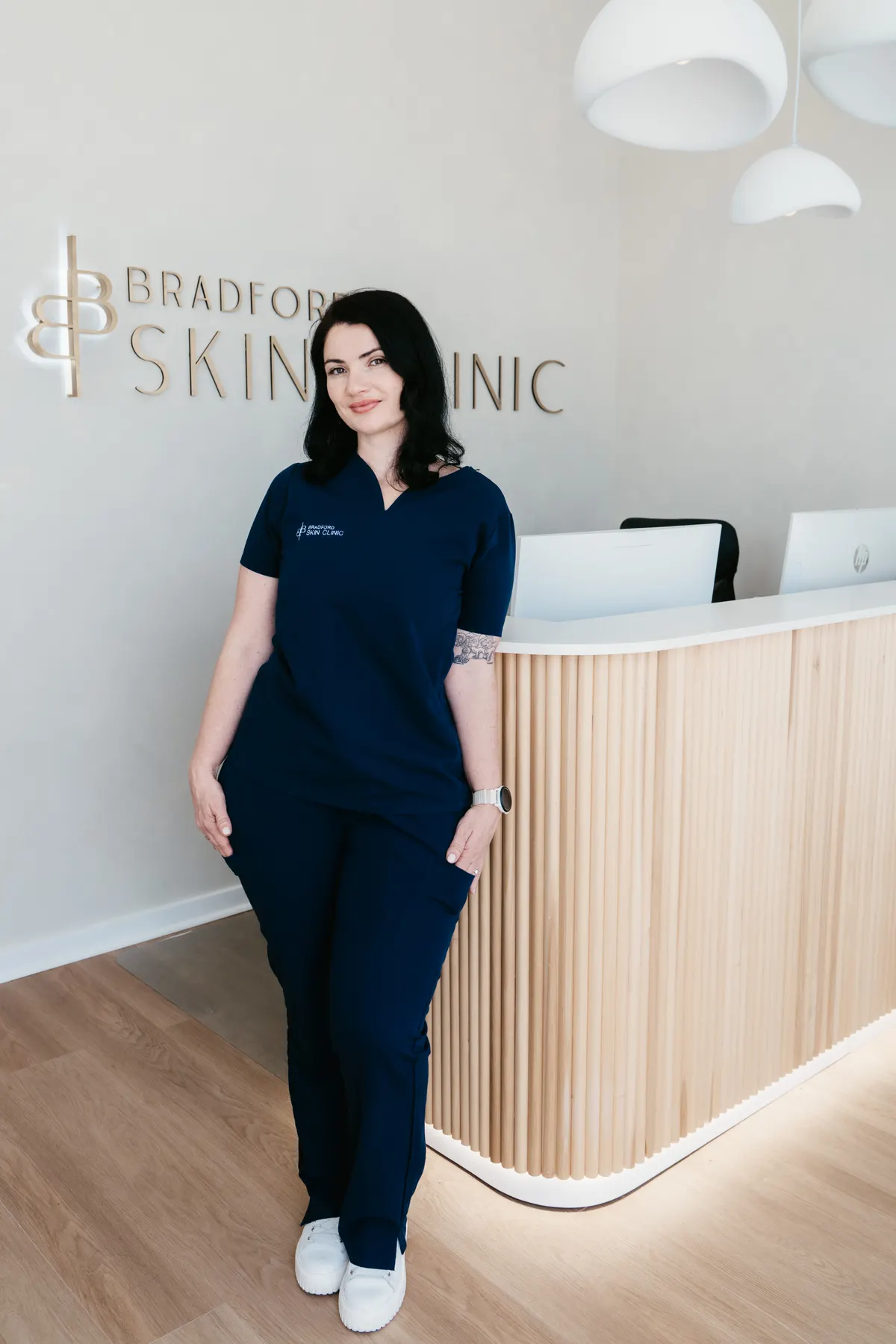
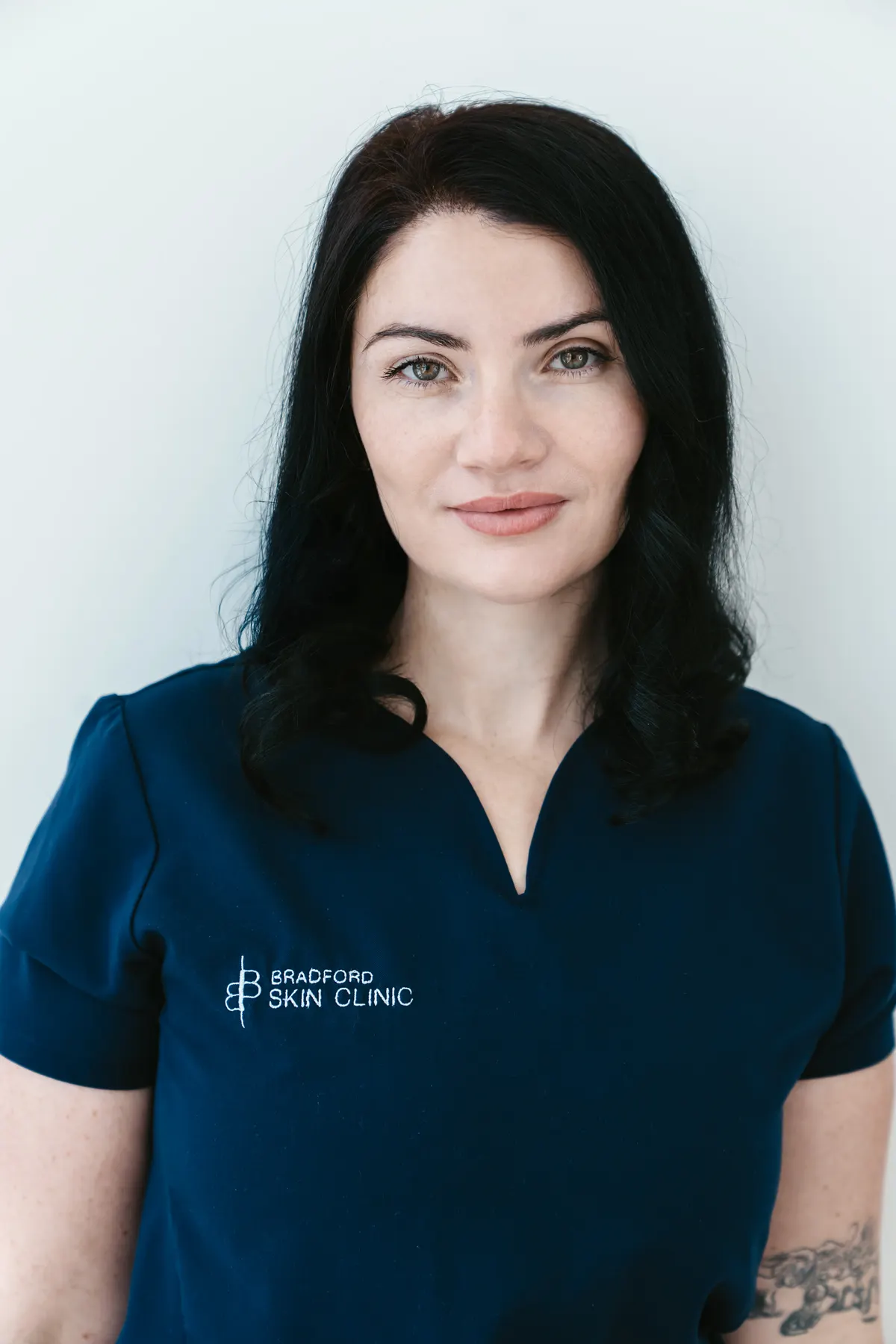
Alex Dinovich, Nurse Practitioner and Medical Director at Bradford Skin Clinic and Medical Spa, acts as medical director for Registered Nurses and Registered Practical Nurses injecting in Hamilton and the western Golden Horseshoe. Authority to inject in Ontario comes from an authorizing mechanism issued by an authorized provider, and that mechanism is valid province wide rather than city by city.
Written and reviewed by Alex Dinovich, NP, Nurse Practitioner and Medical Director at Bradford Skin Clinic & Medical Spa.
College of Nurses of Ontario registration 13564840, verifiable on the
public Find a Nurse register.
Last reviewed .
At a glance
The short version.
InvestmentQuoted per arrangement. Scope, number of nurses and case review volume all move the figure
What the arrangement includes
Included in the arrangement
Directives authored for your practice, not a templateDrafted from what you inject, where, and for whom.
A written escalation plan built around HamiltonNaming the local route for anything you cannot manage, because ours is two hours away and irrelevant to you.
Prescribing for neuromodulatorsWhere that applies to what you do.
Case review by phone and video, with a stated response expectationAt this distance the route to reach the authorizing provider is the whole arrangement, so it is written down.
Broader drafting for a practice we cannot walk intoFewer things can be settled in person, so more has to be anticipated in the document.
Review and reissue as guidance changesIncluding the College's continuing work on authorizing mechanisms in aesthetic practice.
Not included: training. Directorship gives you authority, not technique.
Who you would be working with
A person, not a signature.
Directorship is a professional relationship rather than a
location. You are choosing the person who authors your mechanism, reviews it as
your practice changes, and picks up when a client does not fit it.
Alex Dinovich is Nurse Practitioner and Medical Director here. She is registered with the College
of Nurses of Ontario as 13564840, verifiable on the
public register.
What a directive gives you
Authority to perform the controlled act it names.
A written mechanism you can show.
A named provider accountable for authoring it.
What it does not cover
Anything the directive does not say.
Competence, which comes from training and practice.
Your own accountability to the College for your own decisions.
A directive covers what it says it covers.
Accountability under an authorizing mechanism is specific and bounded.
You remain accountable to the College of Nurses of Ontario for your own practice.
Alex Dinovich, NP. The authorising provider, not a name on a certificate.
The distance question, answered first
Hamilton is roughly two hours from us by road, and we are not going to pretend that is irrelevant. It changes nothing about the law and something about the practice, so here is both halves.
What it changes legally: nothing. Your registration with the College of Nurses of Ontario is provincial. A Nurse Practitioner’s authority to assess, diagnose, prescribe, issue direct orders and author directives is provincial. An authorizing mechanism is valid because of who wrote it and what it says, not because of where the author parks.
What it changes practically: the option of somebody standing next to you. That option has real value occasionally, and if your practice needs it often, a closer arrangement is the better answer and we will say so in the first conversation rather than after you have signed something.
What a remote first arrangement has to do differently
Most directorship, at any distance, runs on documents, phone calls and email. A two hour gap simply removes the escape hatch of dropping in, so three things have to be done more carefully.
The drafting has to anticipate more. A nurse practising where the director cannot easily attend needs a document that covers ordinary variation without a phone call before every treatment, while still stopping clearly at the point where consultation is required. Too narrow and it is unusable. Too broad and it is not a real mechanism. Getting that line right is most of the work.
The route to reach the authorizing provider has to be explicit. Not “you can always call”. A stated route, a realistic response time, and an agreed answer for what you do with a client in the chair while you wait. An arrangement where consultation is technically permitted but practically slow is the one that fails on the day you need it.
The complications plan has to be local to you. This is the detail distance makes obvious. Our emergency routes are no use in Hamilton. Your plan should name the department you would use, what you send with the client, who you call on the way, and what you document. For filler emergencies in particular, where the window is short, the plan has to be something you can execute without phoning anybody first.
Hamilton and the western Golden Horseshoe
The same arrangement covers Burlington, Stoney Creek, Ancaster, Dundas, Grimsby and the Niagara side. The route to us differs, the regulatory position does not.
Hamilton has a large nursing workforce, with McMaster University and Mohawk College both feeding it, and a steady flow of nurses moving from hospital work into aesthetics. If you are making that move, the thing worth understanding early is that the order is competence first, authority second, and that no course supplies the second. How to become a nurse injector in Ontario sets out the sequence, and the CNO aesthetic services guideline summarises what the College published in July 2026 and what it means for your practice.
What you are paying for, and what you are not
A fee for directorship buys authorship of documents specific to your practice, maintenance of those documents as guidance changes, prescribing where it applies, a defined level of availability for case review, and an agreed position on complications.
It does not buy competence, it does not buy blanket responsibility for your practice, and it does not buy authority in the abstract. You remain accountable to the College for what you do. What directorship costs lists the six factors that move the figure and the questions to ask before anybody quotes you one.
Who you would be working with
Alex Dinovich, FNP-PHC, Nurse Practitioner and Medical Director at Bradford Skin Clinic and Medical Spa, College of Nurses of Ontario registration 13564840, which you can and should verify on the public register. She injects daily in her own clinic, which is the difference between a director who has met the complications you are planning for and one who has read about them.
If an NP versus physician comparison is where you are stuck, that page answers it. If you are elsewhere in the province, directorship across Ontario covers how the arrangement works region by region.
Starting the conversation
Tell us what you inject, where you inject it, and what you are competent to manage yourself. We will tell you what the directives need to cover, what availability looks like at this distance, and what it costs. If a closer arrangement would serve you better, we will say that.
Call 647-333-6805. Bradford Skin Clinic and Medical Spa, 444 Holland Street West, Unit 2, Bradford, Ontario.
Asked by nurses
Asked and answered.
Is it sensible to have a medical director two hours away?
It is common and it is workable, provided you go in with your eyes open. The documents and the prescribing are not geographic, and most case review is a phone call with photographs wherever the parties live. What distance costs you is the option of somebody looking at a client in person at short notice. If your practice regularly needs that, you should weigh a closer arrangement, and we would tell you so.
How far is it, actually?
Around an hour and a half to two hours depending on the route and the traffic. Highway 403 to the 407 and north to the 400 is the usual run, with tolls on the 407. The untolled alternative through the Queen Elizabeth Way and Highway 427 is slower and much less predictable. Most Hamilton arrangements never involve the drive at all.
What should I demand because of the distance?
Three things in writing. A stated route to reach the authorizing provider and a realistic response time, not just permission to call. A directive drafted widely enough that ordinary variation does not require a phone call before every treatment. And a complications plan that names your local escalation route, because an emergency department near us is no use to a client in Stoney Creek.
Does the College require the director to be in the same city?
No. The College of Nurses of Ontario registers nurses provincially and the authority comes from the authorizing mechanism, not from proximity. What the College does expect is that the mechanism is appropriate, current, and that you practise within it. A directive that is unworkable at a distance fails that test regardless of the kilometres involved.
I trained at Mohawk and work in a clinic in Westdale. Does any of that change the arrangement?
Your training history matters, because competence is the thing a director has to be satisfied about before authorizing anything, and where you trained is part of that evidence. The location of the clinic matters mainly for the escalation plan and for the storage and handling of prescription product. Neither changes the legal shape of the arrangement.
Can we do the whole thing without meeting?
Yes, and most arrangements at this distance do. Authorship, review and case discussion run on phone, video and email. If you would rather meet once at the start, you are welcome to come up, but we would not ask you to drive two hours to sign something that can be signed properly without it.
Sources
Where this comes from.
Everything on this page is drawn from the regulator, not from a
competitor's marketing. Read the originals rather than taking our word for any of it.
General information about Ontario regulatory requirements. Not
legal or regulatory advice. Nurses remain accountable to the College of Nurses of Ontario
for their own practice decisions.
Talk to us
Ask before you commit to anything.
Leave four details and Alex will come back to you directly. If what
you need is not something we do, we will say so and point you at whoever does.


 Written and reviewed by Alex Dinovich, NP, Nurse Practitioner and Medical Director at Bradford Skin Clinic & Medical Spa.
College of Nurses of Ontario registration 13564840, verifiable on the
public Find a Nurse register.
Last reviewed .
Written and reviewed by Alex Dinovich, NP, Nurse Practitioner and Medical Director at Bradford Skin Clinic & Medical Spa.
College of Nurses of Ontario registration 13564840, verifiable on the
public Find a Nurse register.
Last reviewed .